
How we are charging our electric car? This is a serious question.
Imagine if over a period of time all petrol cars owners get converted to Electric Car owners. Imagine the amount of load that would be put on the Existin Grid during charging of the electric cars. These modern cars would be charging from the old grid that existed 15 to 20 yrs ago, a grid that cannot expand anymore, one that cannot take any more load and such a grid could go offline intermittently and almost on the verge of collapsing completely.

The biggest question is what if the entire grid fails for a few days or months?… during periods of War or bad weather.
|
Who knows when our government will clean up our grid? Is it worth waiting?There are only 2 solutions to this:
1. Make it mandatory for all electric cars to be sold with Solar Panels on their Roof. 2. People have to install solar panels on their houses/buildings to create their own Electricity (this will mean the people will maintain the panels individually and Govt saves money on cleaning and maintaining the panels).Is installing Solar Panels Feasible for India? 
Shi Zhengrong, founder and CEO of Suntech Power has said that, as of 2012, un-subsidized solar power is ALREADY competitive with fossil fuels in India, Hawaii, Italy and Spain.
Shi Zhengrong, founder and CEO of Suntech Power has said that, as of 2012, un-subsidized solar power is already competitive with fossil fuels in India, Hawaii, Italy and Spain. He said “We are at a tipping point. No longer are renewable power sources like solar and wind a luxury of the rich. They are now starting to compete in the real world without subsidies”. “Solar power will be able to compete without subsidies against conventional power sources in half the world by 2015”.
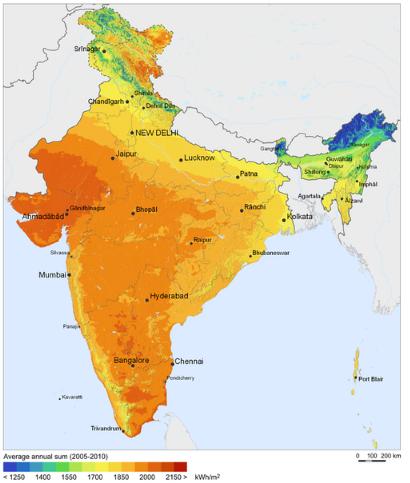
India as a country has excellent solar irradiation and having 300 clear, sunny days out of 365 in a year.
India as a country has excellent solar irradiation. With about 300 clear, sunny days in a year, India’s theoretical solar power reception, on only its land area, is about 5000 Petawatt-hours per year (PWh/yr) which is a thousand times greater than the domestic electricity demand projected for 2015.

India along with China create 70% of food for the entire world. (Remember China is 3 times the size of India.)
Excellent Solar irradiation is one of the reasons India is an Agricultural and Diary powerhouse in the world as crops require perfect sunlight right throughout the year and dairy cattle directly rely on the crops. India along with China create 70% of food for the entire world. (Remember China is 3 times the size of India.) Although India is the biggest milk producer in the world we do not export milk, yet we export food to many countries in the world, and as such, we have a responsibility to keep doing so. Especially to the desert countries of the Middle East and the heavy snow covered countries of the northern hemisphere where farming is not possible due to extreme weather for the greater part of the year.

So very few countries with dark green colour & blue :-(. Those who have it should not loose it… you are either born with it or you don’t have it. People exist … because… food exist. The next war could well be for food and not for OIL!
In India although the amount of Solar panels installed is quite less, yet, India is ranked number one in terms of solar energy production per watt installed due to solar irradiation of 1,700 to 1,900 kilowatt hours per kilowatt peak (kWh/KWp). Thus Solar Power Generation is definitely India’s strong point.
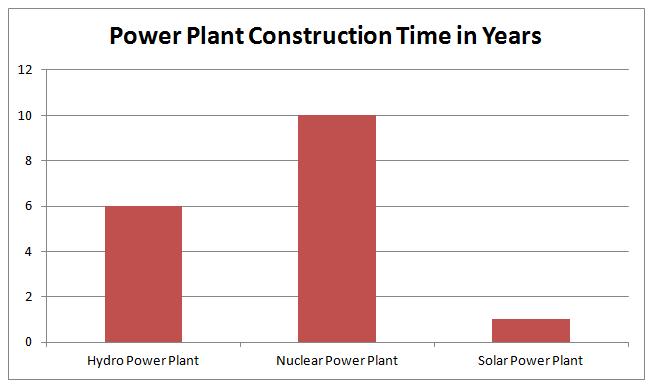
The cost and time required for construction of a Solar Power Plant is very small in comparision to other power plants.
One of the biggest mistakes I am afraid India might commit is to giveaway fertile agriculture land to create Solar Energy. I have seen photos of hundreds of acres of land where solar panels are installed on the ground. These very panels could have been raised up a floor level and the ground could have been used for agriculture. Even those grounds in the desert once there is adequate shade from the solar panels and proper soil cultivated then greenery can blossom.Whatever solar development happen it has to grow hand in hand with our fertile Agricultural land anything else would be a grave mistake and also a crime against other nations in the world. Solar Panel installation should not cannibalize on land. All Solar installation should have dual use.
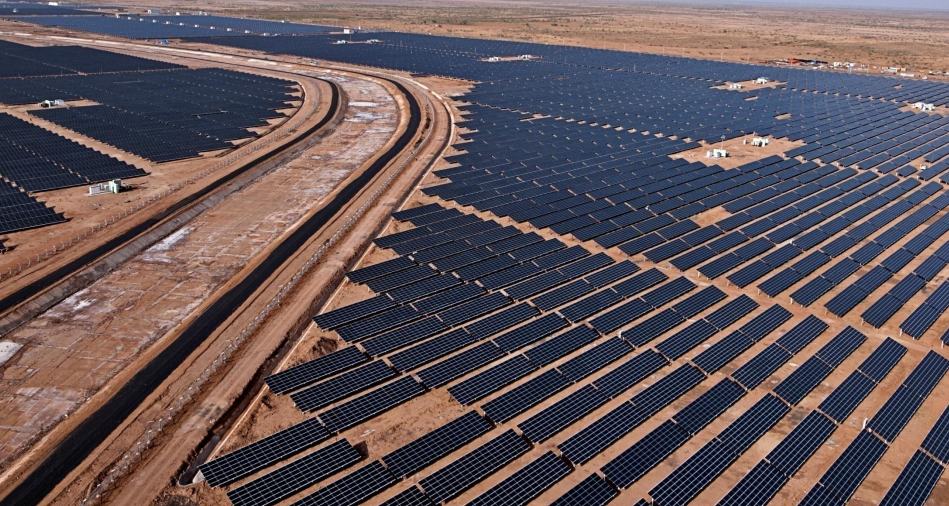
Charanka Solar Park Gujarat – Was this a fertile Agriculture Ground? What we gained from Solar will we loose in Agriculture? Waste of land space….probably sold to companies at very low price. All Solar installation should have dual use. These solar panels could have been installed on any city buildiing terrace and it would have protected the roof from heat, rain and leakages!!!
Reliance has for example proposed to cultivate 35,000 km2 (8,600,000 acres) area of the Thar Desert solar power projects, sufficient to generate 700 GW to 2,100 GW. This is all very good and healthy but they have to make sure that the land serves dual purpose of agriculture and solar panel installation or building a company wear house or factory and covering the external wall and fences with Solar Panels.This will also help in protecting the external walls against rainfall and elongating the wall’s life. The rainfall runoff can also be easily collected in separate tanks. There will be a lot of water used over the year to clean the surface of such panels. This water should also be reused.

On 18 November 2009 India launched its National Solar Mission with plans to generate 1,000 MW of power by 2013. But by July 2012 itself India went from 2.5 MW (in August 2011) of grid connected photovoltaics to over 1,000 MW.Storm of Factors:
India presently is facing a perfect storm of factors that will drive solar photovoltaic (PV) adoption at a furious pace over the next five years and beyond.The falling prices of PV panels, mostly from China but also from the U.S., has coincided with
All the above factors have helped to increase solar adoption in India. But perhaps the biggest factor has been need. India, as a growing economy with a surging middle class, is now facing a severe electricity deficit.India is planning to install the World’s largest Solar Power Plant with 4,000 MW Capacity near Sambhar Lake in Rajasthan. Phase 1 of 1,000MW starting within the 1st year of construction. Another plus point of these Solar power plants are they can be installed and commissioned within months as opposed to 10 yrs for Nuclear power plants and 6 yrs for Hydro-Electric Power station.
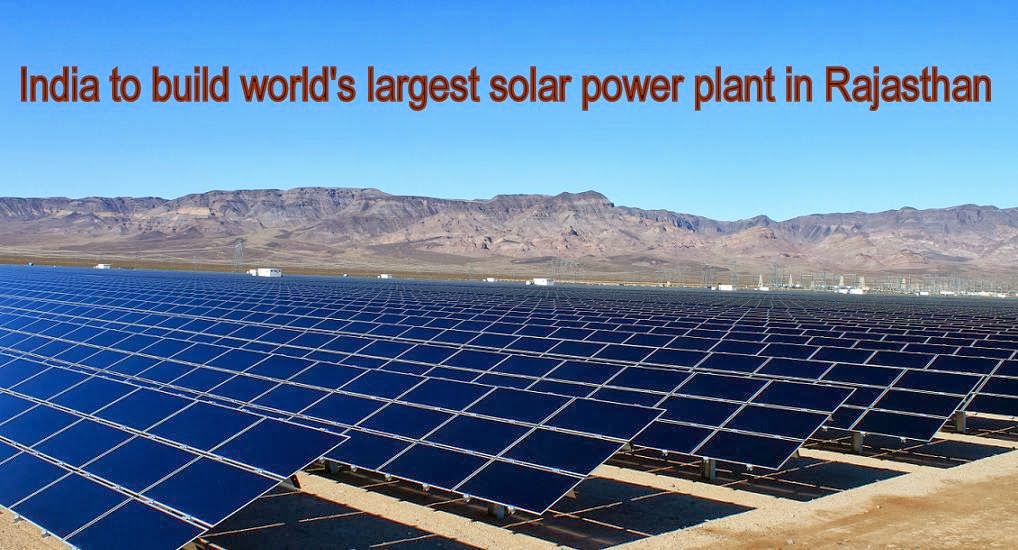
World’s largest Solar Power Plant with 4,000 MW Capacity is to be built near Sambhar Lake in Rajasthan, India. Phase 1 to produce 1,000MW electricity starting within the 1st year of construction! Such short periods are unheard in other kinds of power production.
Installed Solar capacity of IndiaFollowing is the amount of solar energy produced in India in various years:Year 2005 production was 6.4 MW-yr of power as of 2005
Year 2007 production was less than 1% of the total energy demand. December 2010 production was merely 10 MW. Year 2011 468 MW of solar power production was added in 2011 By January 2014 the installed grid connected solar power had increased to 2,208 MW Year 2017 – additional 10,000 MW expected and Year 2022 – Total installed capacity expected to be 20,000 MW 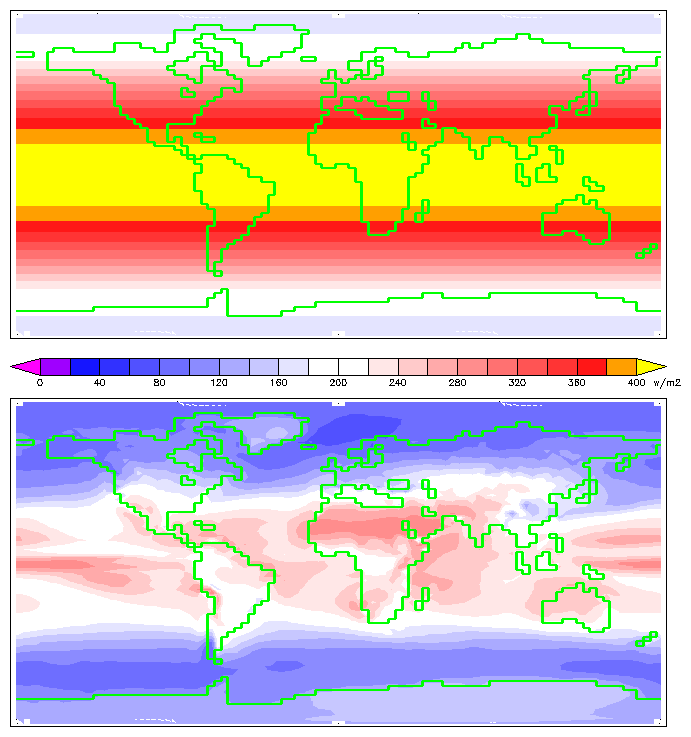
Annual Mean Solar Irridation Map. Strangely most of the countries in the Red Zone have been doing most of the installation.
One Mallu gentleman has stated in his blog (which incidentally got a lot of attention) that plans for production of Solar Power in the state of Kerala is a dud. His whole idea was based on his unscientifically made solar cooker that he had made as a kid which failed to cook.His blog can be found hereTo counter his claims let me put forward at least 6 proof that people can successfully produce solar power in Kerala.
1. Annual Mean Solar irradiation map clearly shows Southern part of India getting more sun. At least more sun than Germany, USA, Norway, Japan, China, etc who are all more aggressive in pursuing their Solar Power goals than India! 2. The success story of Tenhipalam Panchayat. 3. Houseboats in Kerala have started to use Solar Panels. 
4. Solar Powered Electric boats have been introduced in Kerala by Navgathi.

5. In day time people regularly use solar powered calculators even indoors in Kerala. Its proof that electricity can be produced from solar cells.

Electric Vehicles can bring down Inflation:
Once more and more Solar Panels are installed in people’s house across the country not only will grid electricity become cheaper but the cost of charging your car and house electricity charges will reduce… at the same time increasing the agriculture output of the country, using electrical machinery for running the different kind of machinery and helping the produces reach faraway places at cheaper prices. Cost of proper storage by way of refrigeration, cooling or processing will come down. Cost of transporting 4 times the distance will be ¼ the price. As more and more Trucks become Electric Trucks the cost of transportation of food grain will reduce greatly. The whole effect of Electric Vehicles can in reality bring down Inflation drastically!Thus… how we charge our car is a very serious question! |
 PlugInCaroo... Karo plugin... abhi!... save the environment!!!