
“Water water everywhere not a drop to drink” is a quote that fits perfectly on India. With an average rainfall of 1,083mm and 306 rivers… India has enough freshwater to fulfill all its needs.

|
A big part of it is played by the high mountain ranges spread equally in all four corners and even the centre of India namely Sahyadri , Aravali, Vindhya, Eastern and Himalayan ranges.These mountains have very large surface areas and they trap rain water in cavities within the mountains and hold them for months after the monsoon.

Biggest Country – Russia, Country with biggest water bodies – Canada, Country with biggest percentage of Fresh Water to Land Area-India.
The Himachal mountain range have a unique part as due to the effect of snow forming at night and thawing under the heat of the sun during daytime, it produces rivers that never run dry. Always be careful of playing in a small stream around the Himalayan region as a gently flowing stream during sunrise, could turn into a raging river by midday and go back to be the trickling stream by sunset.Due to the above reasons India is blessed with the world’s highest ratio of fresh water vs land area in the World… yet almost the whole of India is under perpetual water shortage especially to irrigate its fields. There are two reasons for this: 1. Lack of electricity. 2. Total failure to trap rain water.

Indian Mountain Ranges (marked in brown lines) – are the water storing tanks of the country.
Solar-powered water pumping solutions is the best way to overcome the 1st problem…that of shortage of irrigation and drinking water for rural population in India. This can be achieved by setting up solar PV panel combined with electric pumps in remote rural regions of India. Solar powered irrigation pumps are cheaper, longer lasting and more reliable than diesel powered irrigation pumps.

Diagram showing how the Solar Powered Irrigation works.
Solar powering of irrigation pumps has a strong economic rationale compared to high cost of providing last mile electricity connection to villagers, savings in power subsidies given for agriculture. In Punjab, for instance, the ruling Shiromani Akali Dal- BJP party, is giving free power to over 10 lakh farmers in the state, entailing an expenditure of over Rs 4,778.13 crore (US$7.9 million). Generally an Irrigation pump needs a 3 HP motor to draw water from deeper tube well this cost around Rs 180,000 ($3,000) almost as much as a Nano car. In some places famers are complaining that 3 hp is not enough and are demanding 5 and 10 hp solar pumps. The fear of unsustainable groundwater extraction, sinking water tables are misplaced as the ground water extracted will go back to the ground as the farmer irrigates his land.

Benefits of Solar Powered Irrigation

Implementing a Solar solution for irrigation need not necessarily have battery packs to store the power as the irrigation happens during sunlight hours. But it is always better to use batteries as it stores the excess power and it can be used later or by the farmer’s household. If buying a set of solar solution is expensive a Portable Solar cart with pump can be built and can be lend out on rent. The cost of such a pump can be shared by multiple farmers. It could even be given out on rent to power various temporary village activities other than irrigation.Another solution would be to build a huge common solar panel roof where the villagers can bring their batteries to recharge and pay a small fee for the upkeep & cleaning of the solar roof.

India V/s Rain deficit countries. India although being the 7th biggest country averages 1,000 mm rainfall throughout the year and is crisscrossed by rivers.
Solutions to trap the water: One of Mankind biggest challenge is the trapping of rain water into artificial ponds or lakes instead of letting the water flow into the sea and is lost for use. Generally people 100 yrs ago were better at trapping rain water than what we are today. In all parts of the world trapping of rain water was extensively practiced.

To avoid theft these panels are fitted with anti-theft nuts and each panel has its unique serial number and RFID
Movie Star Amir Khan discussing the problem of water- Water – Every drop counts:
Building more Bunds, Ponds & Tanks to catch rainwater locally: Traditionally the ancient people used to build bunds and tanks to trap the water in areas of low rainfall. In Cities like Mumbai they were called “Talao” hence there are names in Mumbai like Dhobi Talao, Bandra Talao, Thane Talao, Bhayandar Talao. Each area had its own rainwater catchment area. Lately people have forgotten the benefits of such catchment areas and these are ignored especially with the World Bank Funded Storm Water Drainage (SWD) systems that are constructed to take the rainwater directly to the sea without allowing it to settle locally. Such Drainage systems are the main reason for the falling water table.Not only SWDs are an utter waste of money but also the rain water gets wasted into the sea. With SWDs large areas get flooded whenever an end point is blocked or flooded. This is the reason Mumbai gets flooded whenever there is continuous rainfall during high tides. On one hand the advice is handed out to conserve rainwater and on the other such Storm Water Drains get built to carry the water to the sea.Rainfall which is the only source of water (other than melting snow in high range mountains) are nature’s blessing but the sad part is majority (90%) of this water is allowed to flow downstream and is lost into the sea before, during and after he monsoon. Add a bout of heavy downpour and problems of flooding occurs, leading to loss of land and human tragedy.
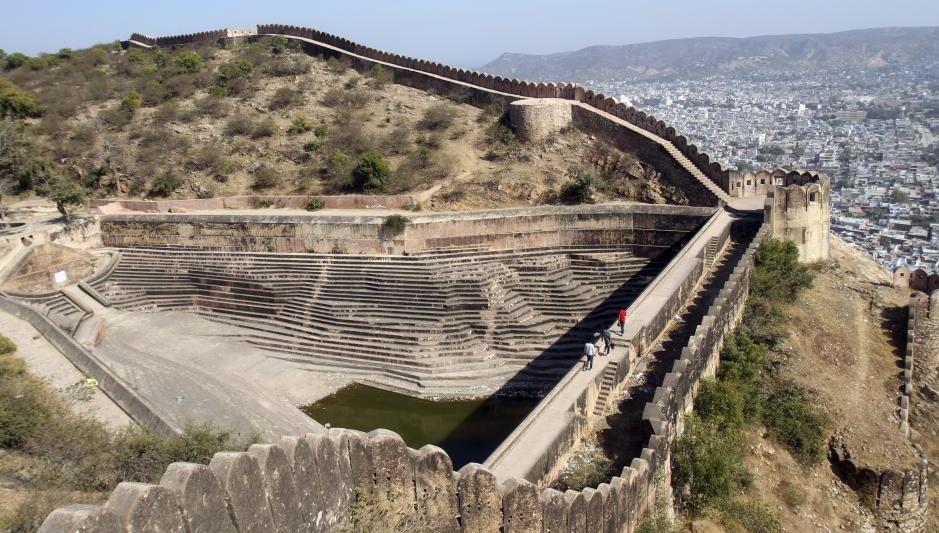 Step well of Nahargarh fort in Jaipur, Rajasthan – REUTERS -Altaf Hussain Files When was the last time we built something like the above images – Step Tanks to catch water? Lots of buildings have “gone upwards” but no building has been made “downwards”. These Step Tanks were common architecture all over India till very recent.

Methods to lower flooding:1. Dredging the streams, rivers & lakes: The way to mitigate such floods is to dredge up the entire length of the river, both upstream and downstream to make it deeper and carry higher capacity of water during monsoon and building deeper tanks and pools to hold the local rain water. These local ponds can double up as water sports arena. A good rule of thumb is “there must be as many tanks of water as there are schools, and the size of tanks should be equivalent to half the volume of each school”. These tanks can have fish breeding, aqua-culture and water sports.2. Regular cleaning and deepening of the above mentioned Civic catchment areas.

Johad constructed by Rajender Singh in the Desert of Rajasthan, India
Rajendra Singh is a well-known water conservationist from Alwar district, Rajasthan in India. Also known as “waterman of India”, he won the Ramon Magsaysay Award for community leadership in 2001 for his pioneering work in community-based efforts in water harvesting and water management. He runs an NGO called ‘Tarun Bharat Sangh‘ (TBS), which was founded in 1975. He has helped villagers take charge of water management in their semi-arid area as it lies close to Thar Desert, through the use of johad, rainwater storage tanks, check dams and other time-tested as well as path-breaking techniques. Starting from a single village in 1985, over the years TBS helped build over 8,600 johads and other water conservation structures to collect rainwater for the dry seasons, has brought water back to over 1,000 villages and revived five rivers in Rajasthan – Arvari, Ruparel, Sarsa, Bhagani and Jahajwali.
Problem no. 1 “Lack of Electricity” is solved by implementing Solar powered irrigation. But a great deal of work needs to be done on the 2nd problem which is of trapping the immense gift of rainwater that we get from nature. Rajendra Singh has shown us how we can “copy-paste” the stuff that he has done in Rajasthan. We just need 1 person like him in each state if India. We need to build at least 50,000 super step-tanks all over India. Implementing these methods and government support for solar irrigation is a great way to put more food on the table not only in India but also to all countries in the world.
|


 PlugInCaroo... Karo plugin... abhi!... save the environment!!!
Indian business are kept away to a great extent in US and Euro markets citing stuff like “inflameable fabrics”, “fruitflies” “below 200km range for EV”. Which fabric is not inflameable? Which fruit doesnt have fruit-flies as it ages? Which EV except Tesla can go beyond 200km???… Lets do the same eradication to US and Euro products… its very easy if one considers their low RULE rule of “dual-use (solar & wind) technology combined with 1 acre farming or 1acre pond as a must for each acre of installation”… this would be difficult for US & Euro installers but easy for Indian businesses to follow.. Even if US & Euro installers are able to follow then it will be beneficial to India too.
LikeLike