
Updated on 29 July 2023
This course is FREE!!! If you or your friend or relative is interested in starting a Dairy Farm or is interested in pursuing a Dairy Management course then this is the one course that will EVER be needed… in life… and it is completely free! Go through the following videos and you will know how to manage a dairy farm.
It is really shocking to see how many newbies are interested in our Free Online Dairy Farming course but not interested in our FREE ONLINE FARMING COURSE (agriculture course). You will surely struggle as a dairy farmer if you do not know do the farming course because Dairy Farming and Agriculture are two sides of the same coin. You cannot have one without the other because the quality of milk & health of the cow depends ENTIRELY upon the feed you are able to source. If you attempt to do Dairy Farming without knowledge about agriculture you will surely end up in debt traps. These traps are well planned and set up by various govt institutes, banks, insurance companies, and companies selling Dairy machines & equipment. I am not saying you don;t need the machines… but which one to use and when to use will make a lot of difference on your financial success. I strongly suggest you to do the Farming/ Agriculture course before you EVEN think of doing this course.
Once you have done the Free Online Farming Course… and BEFORE YOU START this Dairy course… make sure you 1st read all the text till the end of this blog and ONLY THEN watch the videos. (Else most of the things will not be understood).

Free Dairy Management Course
You will learn:
- What to feed?
- How to Feed?
- How many times to feed?
- How to grow your fodder?
- How to detect disease in the cattle and how to cure it easily and cheaply?
Established Dairy Farms & teaching schools might find the information here SHOCKING & difficult to adhere to… but there is no denying how true it is. The following 4 videos are a must for ANY & EVERY Dairy Farmer in the World!
Beat established dairy companies with this low labor, low cost dairy farming information! Learn all this in the following YouTube videos.
- Dr Sreekumar (BVSc & AH,PGCVH) &
- Dr Sreekala (BVSc & AH,PGCVH):
Both worked as Veterinary officers from 1992 to 2010 in TRCMPU ltd, MILMA, Kerala Co-operative Milk Marketing Federation, Trivandrum, Kerala, India.
From 2013 both are serving as Holistic Veterinarians for:
- Gokuldham Vedic eco-village project (60 cows),
- Ahmadabad ISKCON farm project &
- Mayapur Goshala (400 cows).
They also serve as Freelance Holistic Veterinarian for Private farm projects across the country. Both of them manage various diseases of cows with Homeopathy and natural remedies.
There is a great possibility that you have landed on this page thinking of starting a dairy farm as a good business opportunity. The initial “research” with “professionals” could have pointed towards the direction of a successful dairy farm business… until you realize that the very livelihood of these so called “professionals” depend upon “YOU STARTING A DAIRY BUSINESS”. You are their potential CLIENT (“BAKRA”).

Subsidy = “Saanp Seedi” (snake & ladder) game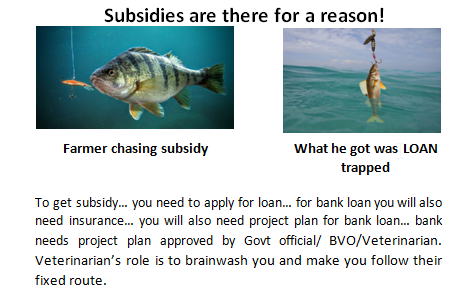
Learn about how (Bank + Loan + Insurance) companies fool Farmers:

Many Dairy Consultants say cow gives milk from front and dung from back… and both are money. But selling water is more profitable… at least water does not require fodder or so much labor.
Its not that there is no money in Dairy Farming. There is money but it depends on how you deal with at least some of the following:
- WHAT kind of milk one is selling? – Inferior low fat HF milk or unhealthy high fat buffalo or superior high fat A2 desi cow milk? Buffalo milk is traditionally considered by ancient Indians to be unhealthy because the melting point of its fat is higher than our body temperature and little more difficult to digest. But it is preferred by dairies for its high fat especially for making curds (youghurt).
- WHO is buying your milk? – Household or companies? Milk processing companies eg Amul Dairy/Mother Dairy (will ALWAYS pay the lowest prices possible especially for HF cow milk) Household people will pay highest price for good quality milk? Do you want to sell a lot of milk at low price… lower than the price of water… or do you want to sell less milk at double that price? If you are selling to companies then you cannot decide the price and you can expect a cut in the prices in future. But if you are selling to people directly then good prices can be demanded only if you are selling better quality product. But 80% of your milk buyers will prefer lower priced milk and will not buy from you. So you will have to concentrate on the 20%. If you are having sustainable practices and your inputs are low then you will ALSO be able to provide high quality milk at low-quality-milk market rates.
- Are you having high fat milk or low fat milk? High fat milk fetches higher price.
- Whether you will be having regular expenses on vaccines? Vaccines are a must for HF and breeds that are not suited to Indian conditions other than Ooty, Shmila, Darjeeling & Kashmir (avg temp below 25deg C).
- Whether you will have regular expenses on Artificial Insemination?
- Whether you will experience regular calf death rates?
- Whether you will have a bull & have control on your breed or let others decide on what genes go into your herd.
- Whether you will have to give away your experienced well trained cows for slaughter every 5 yrs and start again with a fresh lot?
- Your electricity and water expenses? Do you depend on external sources for both water & electricity or able to generate enough on your own?
- Whether you will take regular expense on insurance? Don’t even try to have a dairy farm with non-desi cows without insurance. Insurance cost can be avoided on desi cows.
- Will you build an expensive cow-shed? or let the cows out and stay on the farm under trees or low cost roofs? – Stall fed farms are more labour intensive than kraal farms (rotational grazing).
- How many hands on the farm?… on the farm or can you manage on your own from day 1? Will you use automated milking system or milk each cow on your own? Milking is timing consuming. Time affects the quality of milk. More than anything the person who milks the cow can affect the quantity of milk and the health of the cow. Instead of getting a laborer to milk it is better to get the labor milk the cow with a small milking machine. So if tomorrow the laborer is changed the method of milking will not change. When milk is hand-drawn then there are chances of contamination of the milk from bacteria from the hand. Hand milking is OK ONLY if YOU or someone from your FAMILY milks the cow. You can have two milking machine like this: https://www.indiamart.com/solpack-system/milking-machines.html. This way In 5 minutes you can milk 2 cows and in 10 minutes 4 cows and in 20 minutes 8 cows. It is also possible to milk 24 cows in one and half hrs to 2hrs without becoming too exhausted. Remember you will be milking them only once a day rest of the time calf will stay with its mother & drink the milk. You can start with 1 single drum machine and move on to 2. You will not need more machines soon.
- Who handles and moves the dung? Your laborers? You? Or the dung beetle?
- Rearing cows & rearing goats are completely different thing. In very hilly places and sloping places where it is difficult for the cows… such a place is perfect for goats. It is good to have both… but goats are not really required. It is only sensible to start with one before introducing the other. Due to various factors like ease of training, lower shed-cost, higher intelligence, quantity of dung and urine it is sensible to start with a cow than a goat. Above all it is very important to have AGRICULTURE as a base& build other kind of “FARMING” on the structure of agriculture. Be it dairy, fish or poultry farming… all of it is sustainable only on an agricultural farm. If you don’t have a farm then your expenses will be very high on building a shed & buying 90% – 100% of the fodder.
- Do you have enough space for a farm? If not then it will be even more difficult. For eg: Running a race with one leg is not impossible but it will be very difficult. If you have less space then its better to try a multi-layer farm.
- Would you be using cooling equipment for the milk? Cooling needs 24hrs electricity & expensive cooling tanks. If you convert 100% of milk to ghee (clarified butter) then you do not need cooling tanks AT ALL and have much reduced electricity consumption!
- Talking about electricity… do you have a Solar Power Plant? or depend on govt/electricity company to give you electricity? Your refrigeration will be affected if you cannot create & store electricity.
- Will you sell only milk? or sell processed milk products like curds (yogurt), lassi, buttermilk, cheese, paneer? Or sell only Ghee? Ghee has the longest shelf life… Like wine… it never gets expired.
- If you are going to sell milk… then are there at least 1,000 families within 1 km radius of your place? But even if there are 1,000 people only 20% might take a liking to your product. Are you ok with just 200 customers buying 1 ltr of milk daily?
- Will the customers come to you? Or Will you or your staff go to them? Will credit be given or will it be cash transaction? Online orders?
- Social media engagement – You need at least 3 social media platforms to reach out to people – In 2021 it is YouTube, Facebook, Instagram… (WhatsApp is a messaging app not social media).
- How will you get Electricity on the farm? You will need a minimum of 3kw of Solar power on the farm. You need not use batteries if you can stop all farm activities with sunset and go to sleep around that time. This will reduce your installation cost by half because batteries add to about 25% of the costs. Is better to have at least 1kw Lithium Phosphate battery (written in 2021 over the years newer technologies are expected to make it cheaper and last longer) as it could last for around 10 yrs.
- Rain Water Harvesting is a must on the farm! If your ground wells are running full during rainy season channel your rainwater to the borewell tanks. Never hold it in tanks above ground because it becomes expensive and also takes up spaces. Bigger the tank the more expensive it becomes.
- 200ltrs of milk! Are you able to milk, collect, pack, store and distribute 200 ltrs of milk? For 200 ltrs of milk you will need how much cows? A herd of minimum 40 Indian cows with a sustainable grazing method. So if you have 3 cows in a kraal in an acre… for 40 cows you will need 12 acres… at least!!!
- This is a ratio of 200ltrs:40cows:12acres Or a ratio of 10:02:0.6 which is 10Ltrs with 2 cows in about half an acre. Or the bare minimum ratio of 5:1:0.3 which can be considered as approximately as 5 ltrs milk with 1 cow in quarter acre of agriculture land. This 5 litrs can be sold to 5 families near you. So you have a prospect of earning Rs 6,000 per month with 1 cow (5ltr x Rs40 x 30days). Still Interested in dairy farming? I bet you were multiplying 25ltrs xRs30x30days= Rs 22,500/- and multiplying with 10 cows with a target above Rs 200,000 per month!!! You can try raising 10 cows in quarter acre but then you will have to buy fodder from out of your farm and that too which are inferior quality fodder, pesticide sprayed grass and collect garbage… literally garbage from agrofood processing industries (which are mostly pesticide laden agro waste) as feed. This has been the traditional way of stall fed dairy farms.
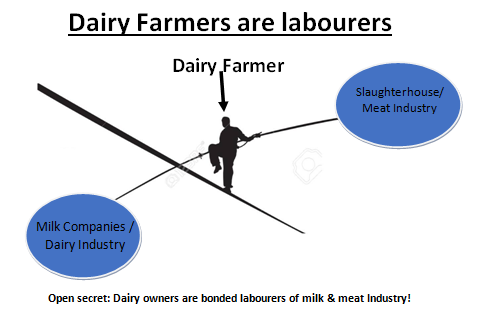
- The argument is YOU will not be able to control the quality, quantity & OUTPUT of your herd if your INPUT is coming from sources out of your control. This is what is taught at even the best Indian Dairy Institutes . All of this will affect the bottom line and the health of the cows. By doing such work dairy farmer has been reduced to being just a bonded laborer whose job is indirectly to rear the heifers for 5yrs before it is sent to the slaughter house. The existing model of Dairy farms (the world over) are just a front for slaughter houses.
If you are disappointed… try selling water!!! Its… kind of the same thing… without ALL the disadvantages and better price.
Pretty confusing… which way to go… right? Don’t worry by the time you have watched all of the videos here you will have answers to every single question. If you still have doubts it means you did not watch the videos properly and go back and watch again.
Let me add… It is usual for dairy farmers to sell inferior low fat HF cow milk to their customers and save superior high fat desi cow milk for their families. In buffalo-milk dairies it is very common to add water…. If this is not cheating then what is?
If you have a herd that is a mix of HF cow and desi cow… and you are selling desi cow milk at higher price then how can the people know that the milk you are selling is not from HF cow? Is this not cheating?
Such an issue will definitely affect the dairy farmer’s credibility. Customers might not say that on your face… but they always know. So its better not to keep both these herd of cows if one is bothered about ones credibility. Moreover by doing such business there is always an opportunity for a new desi-cow-only dairy to come up next to you and take away your business.
There are many problems with HF cow herd. The biggest of them is of dealing with huge volume of inferior milk. Selling huge volume of inferior milk will always be a challenge… even for a small 6 herd dairy. Due to its low fat content it will not fetch a higher price nor will it be good for processed milk products. So most HF dairies sell to milk processing companies at very low rates like Rs17/ltr. This is cheaper than Bisleri water (bottled water)! It will reduce even more in the future as more people get into HF dairy farming.
Check out Rotational Grazing:

In rotational grazing livestock are moved to portions of the pasture, called paddocks, while the other portions rest. During grazing the cattle eats the best grass, avoids eating poisonous weeds and flattens the remaining grass by laying on it. The cattle also urinates and dungs the area thereby providing enough food for the organisms in the earth to nourish it and help regrow grass. This grazed area needs time to recover.

Dung: There is also a wonderful insect called dung beetle which love poop. When cattle poop they also urinate and little of this mixture of dung and urine seeps under the soil and attracts the dung beetle with SMELL. The earth-boring dung beetles (family Geotrupidae) are the best and you need them on your paddocks. These tunneler beetles take the dung under ground for their children. So more the dung… more they multiply.. and more fertile the soil becomes.This is another area where goat poop which is dry and ball-like become inefficient. Cattle dung is very efficient in this area.
This also depends upon the area where you are and what kind of animals were traditionally raised. Different dung beetles have different preference. Some dung beetles prefer the coarse, fibre-filled dung of non-ruminants like primates, horses, dogs, swines and even humans – while others prefer the fluid-filled, fine variety of ruminants such as goats, sheep, camels, goats, buffaloes and deer.A
When it comes to poop, the fresher the better (at least from the dung beetle’s perspective). Once a dung patty has dried out, it’s less palatable to even the most dedicated poop eater. So dung beetles move quickly when an herbivore drops a gift in the pasture.
Dung beetles are really good at finding poop. One scientist observed 4,000 dung beetles on a fresh pile of elephant scat within 15 minutes after it hit the ground, and shortly thereafter, they were joined by an additional 12,000 dung beetles. So a good way to find out if the soil is good and has good quantity of dung beetle is to see how fast poop disappears from the soil top.
Smell of dung is another area how cows can be differentiated. Different kind of cows have different kind of dung-smell. This is a indication of the enzymes in their intestine. There are some cows which do not have a bad aroma and these cows are considered healthy.
Next day the cattle is moved to a new part of the pasture. Every time this happens the quality of the soil improves and this leads to the quality of produce/grass on this soil to improve.
If there is no extreme weather (Snow/Rain/flooding) then cattle can be kept on the farm (Kraals) full time (for day and night), provided ample shade & water source is available for them. If the sun is too hot ensure there are trees in the area which can give enough shade or make a temporary tent to give them relief from the hot sun.
So every paddock they move into they can stay for 24 hrs before moving to the next paddock. So for every paddock there will be need of a tent or shed for them to rest and ample water to drink.
In case there is less grass available in your area you can always try to grow hydroponic fodder in a Low Cost Open Air Hydroponic System like this:
What are the features of a good cow?:
Stall feeding is good or bad?:
Now you may go ahead and watch the videos one at a time! Start with the first video. Complete watching one video before you watch the others else there will be a lot of confusion in your mind.
 PlugInCaroo... Karo plugin... abhi!... save the environment!!!
I will like to enrol for the course.
LikeLike
You can watch the links on youtube… its free… no need to enrol
LikeLike
I like the course content .i have a master’s degree in human nutrition.want to do a course in dairy nutrition n management.. But want a certificate also so it can help me professionally. Pls guide.
LikeLike
I am need a certificate for diary training program as urgent as possible please enrol for the cours and help me getting cours certicate.
LikeLike
Pingback: Free Online Dairy Farming Course – Part 2 of 2 | PlugInCaroo… Karo plugin… abhi!… save the environment!!!