
India’s electric two-wheeler landscape has undergone a seismic transformation in just a few short years, and at the forefront of this electrified revolution stands Ola Electric. With a remarkable 7,77,118 electric scooters sold since its entry in December 2021, Ola has not just disrupted the market—it has redefined it.
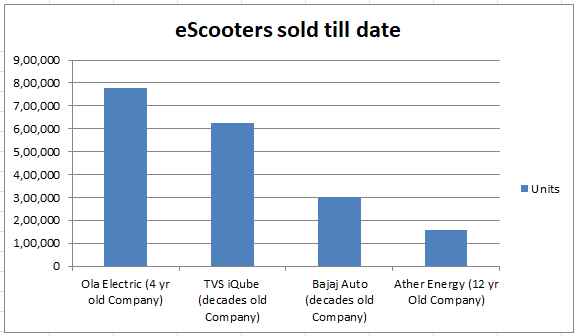
While legacy brands like TVS Motors, Bajaj Auto, and Ather Energy have made notable strides—with cumulative sales of 6.26 lakh, 3.03 lakh and 1.55 lakh units respectively —Ola Electric has far outpaced its competition.
Today we take a look at why Ola Is Leading the Pack?

1. First-Mover Advantage with Scale Ola entered the EV space with bold ambition and scale. Its FutureFactory, touted as the world’s largest two-wheeler factory, gave the company the ability to produce at a pace unmatched by competitors. This massive production capacity turned demand into quick delivery—a crucial advantage in a time-sensitive market.

2. Direct-to-Consumer (D2C) Sales Model By eliminating traditional dealership channels, Ola took complete control of its customer experience. This D2C approach allowed for competitive pricing, seamless communication, and direct servicing—factors that have deeply resonated with India’s increasingly digital-savvy consumers.

3. Aggressive Product Lineup and Features From the original S1 to the new, more affordable S1 Air and S1X variants, Ola has diversified its offerings to appeal to urban commuters, value-conscious customers, and tech-savvy riders.
Their scooters stand out with features like a touchscreen dashboard, app connectivity, voice commands, and over-the-air updates—turning the vehicle into more of a smart device than a traditional scooter.


4. Strong Brand Identity Riding on the reputation of its ride-hailing business, Ola Electric tapped into a ready-made consumer base. Additionally, its vocal and high-profile leadership, coupled with bold marketing campaigns and launches, has given the company an almost Tesla-like allure in the Indian context.

5. Pricing and Incentives Ola also strategically utilized, PLI Scheme, FAME II subsidies, state-level incentives, and attractive financing to make electric scooters financially viable for the masses. The result? A perfect product-price fit.
6. Rare Earth Magnet Problem:

China’s tightened control over rare earth magnet exports poses a significant threat to India’s automotive industry, particularly its electric vehicle (EV) sector, due to the country’s heavy reliance on Chinese imports.

Ola’s rise has done more than increase sales figures—it has galvanized the entire industry. Traditional players have ramped up their EV portfolios, new startups are rushing in, and consumer interest in e-mobility has never been higher.
Ola has forced an acceleration that benefits the planet, the economy, and the consumer.

Ola Electric’s meteoric rise is a mix of timing, innovation, daring strategy, and visionary scale.
As of 2025, the company doesn’t just lead in units sold—it leads in setting the pace and shaping public imagination.
In the race toward a greener India, Ola Electric isn’t just participating—it’s steering.
 PlugInCaroo... Karo plugin... abhi!... save the environment!!!