
“How to Farm?”… is a fundamental question… how man sources his food…is the one question that should come to everybody’s mind sometime in their lifetime. But the sad part is that neither does it come to the minds of most people nor to the newbie first time farmers in their effort to learn farming. The truth is that they try to think… “how to make maximum profit from farming or diary farming“.
20 yrs ago the person who took to farming used to be the school dropouts. Parents warned their children that “if you don’t study well you will end up as a farmer”. But today a lot of educated people like Doctors, MBAs, IT guys, Lawyers, etc are returning to take up farming as they are fed-up of their unending deadlines, stress, daily, weekly and monthly targets, unhealthy lifestyle and food.
The good news is that lot of educated people are returning to farming… but the sad news is that a lot of them are not asking the right questions and thus falling prey for traps laid out by international agencies who mask themselves as Institutes, Consultants & Advisors for farmers!
If farmers do not tread carefully they could end up with a noose around their neck (suicide) …after all you are competing directly with some of the most powerful & cutthroat organizations in the world, like Bill Gates and Monsanto… for control over WATER and SEED.

How to Farm?
But the biggest mistake they do is they try to… replicate what they did in their Companies, Offices or workplaces… which is to approach a senior, or a consultant or a qualified person to advice them.
They do not try to use their brains to understand the simple principles of farming. You put in a seed and then it grows into a tree. It cannot be more simple. There is no simpler work than this. Even if you dont grow anything the birds will start to drop seeds on your soil to grow food.
There is no job in the world that is more simpler than sitting back and watching nature grow. Plants and fruiting trees grow in the jungle and forest for heaven sake with any human help.
Many a time a person who is new in farming may be very well qualified in their field of work but is new in farming and do not understanding farming. So they attend some training course at, where else but, the nearest Agriculture Institute .
Most of the time the people at the Agriculture Institute copy paste what was taught to them. Most of the that stuff would be a copy paste of the Western methods of Large Scale Mono Crop Agriculture and Diary Farming. This is one of the dumbest way to learn farming. The methods used in a hilly country cannot be used in a desert or flat land.
Water harvesting is a big topic that is not properly taught to farmers and different region need different kind of harvesting methods.
Thus the newbie farmers take up the matter as it is taught to them without evaluating it or giving it deep thought. Its shocking to see many of them involved in chemical farming and vermiculture.
Therein lay the danger. Many a times the people providing training stand to benefit directly or indirectly from what they advice. Most of the advice is “go for hybrid seeds”, “go for hybrid cow”, “go for high-tech precision farming”, “go for greenhouse”, “go for hydroponic”, “go for bank loan”, “here I have project report for bank loan”, “go for subsidy” “go for Insurance”, “cow gives money from front and back… milk from front and dung from back and both are money”, “do vermiculture”, “farming must not be done in traditional way but by advanced hi-tech way”, then they ask the all important question “can we feed our population with traditional farming?” These are the magic words to trap the newbie farmer.
ALSO READ: How to farm – Quick Tips
The truth is there is much more food that is rotting away in govt storage facilities than ever… so much so that even if you double your production then also it will still not reach the needy. So don’t worry about feeding the multitude.
The Agriculture and Animal Husbandry institutes were opened with the VERY INTENTION to “CHANGE” traditional Indian Agriculture and Indian cow breed and to turn it towards the western modern or LARGE SCALE methods of farming and stall-fed diary farming using Jersey so that the Western and European countries would make good income from it.
The beneficiaries were Seed companies, Chemical companies, Pharmaceutical companies, Veterinarians, Insurance Companies, Banks, Milking machine companies, cooling & refrigeration companies, Tractor companies and even the Government Officials…. and the ONLY loosing party here is the Farmer.
Every single one of the above other than the farmer benefits from a farmer/dairy farmer. Even today the newbie farmer is enticed through “Subsidies”& “Loans”. To say the “change agents” have succeeded in destroying the fundamentals of farming is an understatement. Today it is very difficult to get a native variety seed or a pure breed local cow.
Vermiculture is not good for Indian Subcontinent: India is a monsoon heaven. India gets a lot of rainfall and it is very important this rainfall travel underground on the farm and this is possible with the help of ground burrowing earthworms and not with vermicomposting worms.
Vermicomposting It is a process that uses a certain type of earthworm to stay inside a “bin” and decompose the food waste. Why vermicomposting is not good on Indian farms:
1.First it is time labor consuming you have to attend to it to create the compost
2. Requires movement: You have to move the compost from the pit to different placces on the farm this again needs labor and carrying time/cost,
3. These vermi-earthworms do not create burrows or shift soil inside your farm.
4. They play no role in water harvesting.
Thus Vermicomposting is good only in snowfall or cold countries or in desert countries. It can be used in pot farming or in terrace garden where plants are grown in pots on a terrace or balcony of buildings. In all other cases Vermicomposting should NOT RECOMMENDED on FARMs ANY WHERE IN INDIA.
Earthworm-culture:
Although both cultures need earthworms the fact is the earthworms in Vermiculture and the earthworms in “Earthworm-culture” is as different as chalk and cheese. Vermi-worms do not bore the earth, while Earthworm-culture-earthworms creates bores & tunnels in the earth.
Earthworm-culture is the natural or ancient Indian process of cultivating and encouraging earthworms and dung Beatles on farm land as they not only shift soil up and down but replicate fast and create millions of tunnels inside the soil to hold rainwater until it percolates to nature’s underground tank.
It is for this reason the community of Jains do not uproot food that grows under the ground like onions and potato as it will destroy organisms in the earth. Use of chemical fertilizers and pesticides will also kill the earthworms, dung Beatles and bees.
Bees increase pollination and increases the yield by 25%. With chemical farming these bees die. Many other insects like earthworm and dung beetle die thus drastically reducing the rainwater storage ability of the soil.
If chemical farming is used the rain water doesn’t percolate underground but flows over the ground creating floods. Today as we reel under massive floods we prefer to blame it on “climate change”. Instead of ouw own stupidity of using chemical fertilizers and pesticides we prefer to blame it on some other thing.
Today the western farmers are slowly learning these ancient techniques and started to call it “permaculture” or permanent culture which we in India know as natural farming with waterbodies on the farm and for which zero investment is required. The western farming community are today learning about the dangerous effects of pesticides and protesting against chemical fertilizer & pesticide companies.
ALSO READ: Free Agriculture Course Online
Agriculture Loans & Subsidies are the biggest traps planned and laid out by international organisation. Subash Palekar says SUBSIDIES = “Saap-Seedi” (snake & lader). These are well planed and perfected method of trapping a farmer into debt and also wrong ways of farming. You will not get loans & subsidy for everything but only for certain things. By using these loans & subsidies these organisations get the farmer fulfill several conditions eg a diary farmer will need:
- Project Plan
- This Project Plan will be given by a Veterinarian or Bank staff for a price.
- This plan has to be approved by a govt staff eg say Veterinarian (at this point the Vet will brain wash you into buying Jersey or HF cow promising high yield and not to buy desi cow) he stands to gain here as Jersey and HF cow fall sick easily and you call him to treat the animals. Non-Indian cows like Jersey cows are the Vet’s pets… no wonder India is full of Jersey cows as if the country was having temperatures below 20 degrees).
- Once Jersey cows are in…. Pharmaceutical companies stand to gain owing to the constant stream of medicines and injections required by it.
- Drip companies stand to gain as the Jersey cows need fog irrigation and fans for cooling during summer months in India.
- Insurance is mandatory if you apply for such loans. Its suicidal to have Jersey/HF flock in India without insurance because these animals have unhealthy & short life.
- Even the cowshed has to be built in a certain way else the loan will not be approved.
- Once all these are above points are fixed only then the bank will approve the loan. Even then the loans have normal rates of interest no benefit is given to the farmer.
In this process the Vet, Bank, Pharma cos, Drip company, Insurance etc all make a profit and you will be paid much later as a lot of red tape is involved and all these companies pay commission to the enforcing agencies and agents.
Why a Govt Staff has to approve a Bank Loan is beyond any logic when it should have been a staff from the bank that gives you the loan. Any malpractices there can be easily caught with data and regular bank accounting vigilance.
Same is the situation with Agriculture. Even before you start you are trapped by various powerful forces the the strings of which are held across the oceans and the reins of which are held by a few set of people who believe in racial supremacy and the right to control fuel, seed and money.
Websites: Then there are many farm related websites in India that connect the farmers and share information. But many a times these websites are trolled by marketing people from various seed companies, fertilizer companies, pesticide companies, hydroponics, precision farming companies and greenhouse companies… all are busy selling their product… products that is not even required on farms in the first place at least in India… its like selling refrigerator to the Eskimo… promising income in lakhs if the farmers can commit crores… or income in thousands if the farmer can commit lakhs.
These companies are complete frauds and trying to make quick money. No place in India needs Green House and Hydroponics… to see educated people fall for this is really sad. These are very expensive setup requiring investment of about 25 lakhs per acre.
But once they have fallen into this trap they try to trap others to make profit by showcasing their “work” to others… and then others too fall into the trap.
After all they invested 20 to 50 lakhs and the returns are not much so they are forced to hunt for newbies and promise them the sky… this is kind of like Amway or multilevel marketing and has a multiplying effect. Once you buy hydroponics or greenhouse the pressure is on you to find your “bakras”… to break even… The EMI (equated monthly installment) to payback is huge its as if you bought an SUV. EMI dosen’t wait for the crop. The crop takes minimum 3 months but your EMI starts the very next month. Subsidies everything will come only afterwards.
India’s scope: India exported $39 billion worth of agricultural products in 2013, making it the seventh largest agricultural exporter worldwide, and the sixth largest net exporter. This represents explosive growth, as in 2003 net export was about $5 billion. India is the fastest growing exporter of agricultural products over a 10-year period, its $39 billion of net exports is more than double the combined exports of the European Union. So how can they teach us farming?
Farming sector is India’s biggest industry by any account – especially by human resource in it and other related industries like horticulture and Diary Industry, Food Processing Industry, Leather Industry, Paper Industry, and EVEN EXPORT of grains & even vegetables in spite vegies being the most perishable commodity in the Market!!! If there is ANY INDUSTRY that India tops and had been topping in the world for thousands of years it has been Agriculture Produce. And due to the Geography and climate it will continue to dominate in the future too.
India is in the world’s top 5 producer in almost ALL the agricultural produce. The fact that it even comes gross first or second every year in agricultural and diary production. This is also in caparison to some of the biggest countries in the world… some of which are bigger than 3 times the size of India… this is a reminder how effective a country we have been… not from recent chemical farming… but over centuries we have been a big export nation… Indian farming habits were destroyed systematically since around 200 yrs ago during the British mis-Rule and their oppressive taxation policies which were designed to destroy agriculture and the local Economy so that they can employ more Indian population in their army to fight wars.
SOME HISTORY: Of course there have been famines in India but they have been mainly in the rain shadow areas of India and sometimes in other areas when these areas were either affected by war or by mis-rule as done by the British (see Karl Marx) (impact of colonial rule). The destruction of Indian civilization, education, martial arts, trading, business and agriculture was done with intention to create joblessness and force people to join british army. If people were made economically weaker then they would prefer to look for food and jobs than to fight the British. If a farmer lost his land or had no income the next best thing he could do was join the army. In those times the British need more manpower to control all of India thus destruction of agriculture was carried out in systematic manner and laws favorable to it were passed. The major impact of this exploitation had wider ramification because even after departure of British, India has not succeeded in eliminating hunger in India. The phrase of Nurkse, India has been trapped in the ‘vicious cycle of poverty.’
Even today we continue using the British Rules, Laws and Taxation. Even the Land Acquisition Act of British Raj is being used by Indian Government happily today!!! Every day the government is busy inventing new Tax Laws… the latest being Google Tax, NRI-Tax and one fine day the Farmer-Tax.
Chanakiya had said that Taxation had to be reduced to the least to encourage businesses and if there was need to collect more taxes then ways have to be found to increase business and not increase taxes.
But even after all these laws and taxes… still we are able to do better agriculture than other countries that have much better laws, taxes and policies favoring agriculture… WHY? Its only because of our climate that favours agriculture.
We lost the art of Farming: Due to the British meddling for the last 200 yrs in our agriculture we have completely forgotten the ancient art of traditional farming.
Today with so many advances in science Indians don’t know why the Indian Breed of cow was respected by the Ancient Indians. They think Indian Cows and Jersey cows are same because both give milk.
The fact is Indian cow was respected for its special features of dewlap (where Shiva is supposed to reside), the Hump and Surya Khetu nadi all three of which is absent in the Jersey or HF cow.
The Indian cow is known as the magical Kamadhenu “cow of plenty” who provides her owner whatever he desires she is also capable of producing fierce warriors to protect her.
Plenty means that it could make the land fertile and productive. The owner thus could have plenty of food and cattle and these people will also be capable of defending their lands.
The Indian bulls are intelligent, friendly and hardworking unlike the Jersey or HF bulls which are completely useless. For those who argue Desi & Jerseycows or HF cows are same. I request them to please show me a video like the above where a jersey or HF bull is getting in, picking up its cart on its own and walking home.
Today we are taught to save tap water but not taught to save rain water. To understand the scope of agriculture in India, we have to understand Indian Geography a little better and to understand how our country receives water.
Basically we receive water through 2 ways Rain and Snow. Snow water from Himalayas provide water in the north other than rains in the monsoon. Lets understand it a little deeper:
Indian Climate, Geography, Indian Cow Breed has been a biggest contributor to the agriculture might of India.
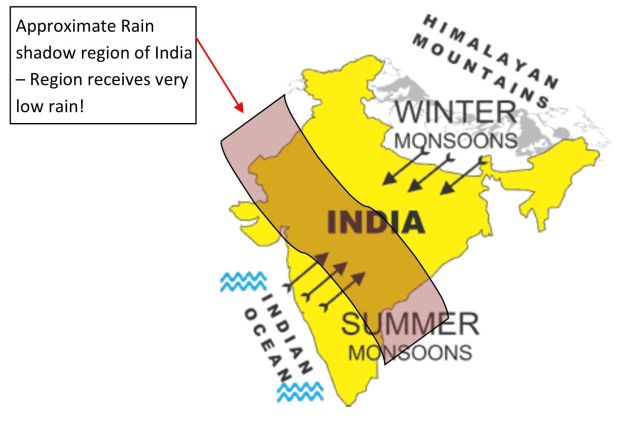
Rain Shadow region of India need heavy 100% water harvesting
Geography: India is enveloped with Water and Rain Winds! On the south there is Arabian Sea, Bay of Bengal and the Indian Ocean. There is only one Ocean in the world that is named after a Country- Indian Ocean.
India can easily create drinkable water from seawater by desalination using solar electricity or solar thermal energy. The 49 landlocked countries like Armenia, Austria, Azerbaijan, Belarus, Bhutan, Bolivia, Botswana, Burkina Faso, Burundi, etc do not even have this choice.
Except for the rain shadow region, all other parts of India receive very heavy rain fall. Indian State Meghalaya gets the highest rainfall in the World and its surrounding states also get very heavy rain. This is because the clouds take longer to climb over the Himalayas.
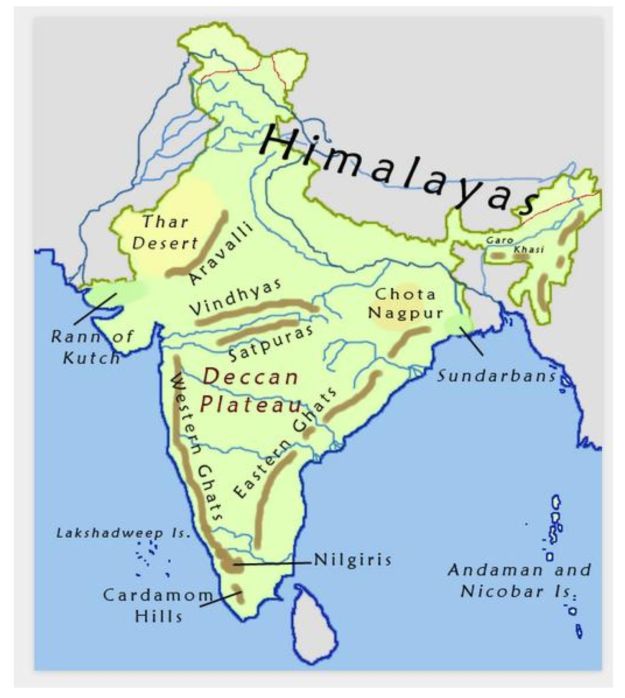
Mountains of India trap rain water
Himalayas generate water during sunrise every day by thawing snow and these results in perennial rivers running round the year! We are not done yet… The country is criss-crossed by mountains.
If modern man would have it he would put biggest drainage pipe and send all the rain water straight into the sea to keep his streets dry and waste the important rainwater.
It but because of the mountain the rain water is trapped inside it and you can see the waterfall long after the rains are gone… where does the mountain get this waterfall even after the rainfall? It is the stored rain water released slowly over the months that become the waterfall!
The biggest problems are the coastal cities are piping their excess rain water into the sea! Just because there is a sea next to your house doesn’t mean we put all our garbage seawage and rainwater in the sea. There is next to zero rain-to-groundwater harvesting done by municipalities in the country.
Some countries like UAE has understood the important role Mountains play in bringing rain. When it rains, water harvesting has a direct effect on agriculture. Thus the desert country UAE is planning to build artificial mountains after they got bored of building some of the tallest buildings in the world.
So if you are a farmer and live in the rain shadow area then YOU WILL HAVE TO HARVEST RAINWATER and save every single drop of rainwater into the sand. YOU CANNOT LET RAINWATER FLOW AWAY… NOT EVEN TO YOUR NEIGHBOUR’s LAND!!! The cost of farm land in Rain Shadow area is relatively cheap compared to other areas. The highest farm rates are in Kerala a land which has the longest rainfall. Cost of real estate is directly linked to availability of water in your area.
Easiest way to make good money is to buy cheap land in rain shadow area and do very big rain water harvesting features and 10 yrs later sell the area at 5 times profit minimum. Rain shadow area doesn’t mean the place doesn’t get any rain. Rain Shadow areas in India also get rain but their frequency is low and the water volume too is less. But this doesnt mean there is no water. Even in rainshadow areas of India 1 day of heavy rain is enough provided the rainwater is properly collected and sent to underground natural tanks (aquifers).
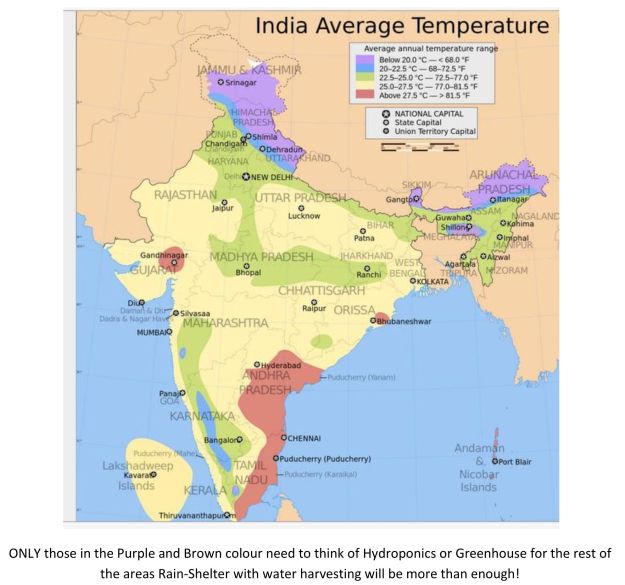
India generally has above 25 Degree Temperature
ONLY those in the Purple and Brown colour need to think of Hydroponics or Greenhouse for the rest of the areas Rain-Shelter with water harvesting will be more than enough!
CLIMATE: This is very important to understand. For almost all seeds to generate it requires humidity and temperature between 25 degrees and 35 degrees. Anything above or below that and farming becomes difficult.
As it is clearly visible in the above map that only places in the Purple and Brown colour need to think of Greenhouse made of plastic, pvc pipes or bamboo. If not greenhouses then at least shade nets have to be used in these areas along with rainwater harvesting. The activity can be started by using shade nets in small areas of 100 feet every month. Moving slowly so as to cover 1 acre slowly in say 3-4yrs so that a big investment is not done on the very first day. This way the money invested will come from profits made from other parts of the farm including dairy, bee, hen, ducks & fishery on the farm.
Professional greenhouses made by companies charge very high prices above Rs 20 lakhs for one acre….and people are falling for this subsidy trick and getting trapped in EMIs. Farmers are not able to pay huge EMI from just 1 aspect and that is agriculture. Farming has to include many disciplines to make a profit. But to pay back this in EMI is too risky especially for a new farmer.
Shade nets & greenhouses are not required in every areas. Indian temperature do not require greenhouses because main function of greenhouses is to increase temperature and bring it to around 30 degrees. But in India most places have temperatures above 30 degrees.
This is exactly like selling refrigerator to the Eskimo. And why the government interested in paying subsidy for fertilizer and greenhouse making companies but not interested to pay crop loss for farmers? Why? Chew on it for a while…
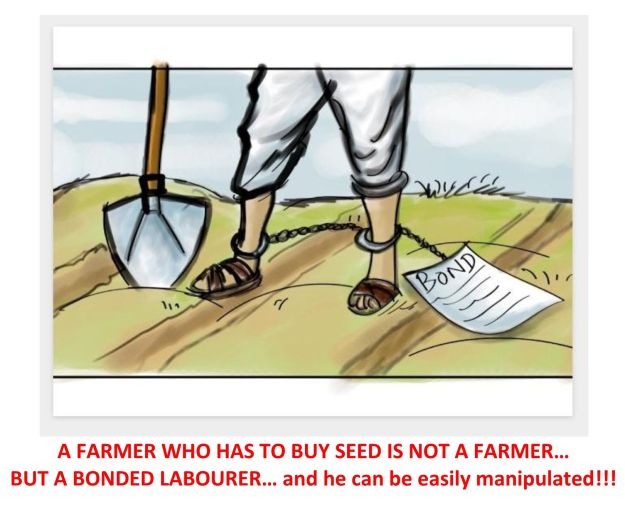
A farmer who buys seeds is a foolish bonded laborer
A FARMER WHO HAS TO BUY SEED IS NOT A FARMER… but a FOOL
and A BONDED LABORER … he can be easily manipulated!!!
SEED CONTROL: A farmer who has to buy seeds is not a farmer but a bonded laborer who has to grow crops for somebody at the rates and cost set by others… he has no say in anything. Above all he can be easily manipulated…. by the seed seller, by the pesticide seller, by the fertilizer seller, by the Insurance company, by the bank-loans, by the governments too.
People are seduced by greed for profit. They are promised “high yields”. Why do you want to pay for a little better yield when the normal yield can be got free!!! If what they promised was true there would not have been a single farmer suicide in India.
For a start if you have no control of your seeds then obviously you have no control over what you grow. Get seeds from a fellow farmer or collect seeds from organic fruits or vegetables. If the guy selling you the hybrid or genetically modified (GM) seed really thinks that the seed variety is amazing wouldn’t he be growing it instead of selling it? Why would he sell it if he could grow a million plants from one seed? Then why is he buying and selling seeds instead of growing it? Wouldn’t Monsanto become the biggest agriculture producer in the world? Wouldn’t it produce so much from its overflowing hybrid and GM farms that it could give free food to the poor countries in the world? But they prefer to sell seeds, pesticides and fertilizers…LOL. If that is not the greatest con then what is?
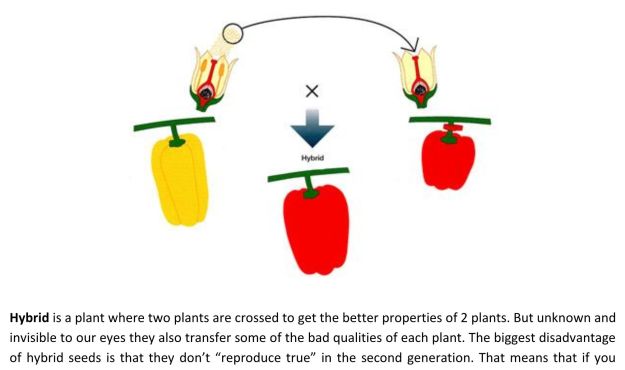
Stay away from Hybrid plants – they don’t reproduce true in 2nd generation
Terminator Seeds: Genetic use restriction technology (GURT), colloquially known as terminator technology or suicide seeds, is the name given to proposed methods for restricting the use of genetically modified plants by causing second generation seeds to be sterile. The technology was developed under a cooperative research and development agreement between the Agricultural Research Service of the United States Department of Agriculture and Delta and Pine Land company in the 1990s.
Hybrid is a plant where two plants are crossed to get the better properties of 2 plants. But unknown and invisible to our eyes they also transfer some of the bad qualities of each plant. The biggest disadvantage of hybrid seeds is that they don’t “reproduce true” in the second generation. That means that if you save the seeds produced by F1 hybrid plants and plant them, the plant variety that will grow from those seeds (known as the second generation) may or may not share the desired traits you selected for when creating the first generation hybrid seed. Hybrids are also prone to disease very easily. Some of the hybrids plants produce sterile seeds and you cannot germinate them and these are the favorite with the seed companies. Because the farmer will come back to the company if he wants to plant new crops… thus the company has control over the farmer and what he grows.
Hybrid or Native/ Heirloom variety?: Heirloom is an old cultivar that is maintained by gardeners and farmers, particularly in isolated or ethnic minority communities. These may have been commonly grown during earlier periods in human history, but are not used in modern large-scale agriculture. Stick to the native or heirloom variety as it has been tested and perfected over centuries rather than a few years for a hybrid plant.
In some parts of the World… certain countries or companies have started a slow slight but sure march for the capture of seed-rights so that they will control the food source of the world irrespective where it is grown. This is exactly how they dominated and profited from were “advised/convinced/coerced” to trade in dollars during Oil Boom when the Gulf States struck oil in huge numbers. The richest man in the world Bill Gates has funded the global seed bank in Norway with such an ulterior motive. After Oil the next richest country will be those who will be able to control seed and water. On one hand they are spreading the crap hybrid variety and on the other hand they are saving the traditional seeds far out of the reach of the normal farmer. Monsanto is used not only to take away seeds from farmers but also water. Large scale droughts and flooding are experienced where chemical fertilisers are used and more severely in the rain-shadow region of India.
In some parts of the world, notably the European Union, it is illegal to sell seeds of cultivars that are not listed as approved for sale. The Henry Doubleday Research Association, now known as Garden Organic, responded to the European Union legislation by setting up the Heritage Seed Library to preserve seeds of as many of the older cultivars as possible. There is an article that asks why does the “Why doesn’t American produce taste as good as Europe’s”? Why is the west chasing after patents when none of them pay patents for the thousands of years of research done by forefathers which arrive in their plate? Another chase to sell Garden Tomato and Big Tomato Patents… read it to believe it!
Today in the market it has become very difficult to get Native/Organic/Heirloom seeds. Most of the time the seed seller himself do not know if the seed is native or hybrid.
If you have to buy seed at all buy it from a fellow farmer who already is profiting from cultivating it only if he doesn’t have to support it with more expenses with chemical fertilizers and pesticides. Usually farmers with the Heirloom variety give their seed free to a newbie farmer and the newbie pays back on his harvest.
Learn about the fraud of by Banks + Loans+ Insurance:
Monocrop or Multicrop?: It is always better to practice Multicrop as it is never wise to put all your “eggs” in the same basket. If you grow a single crop if any disease happens you might lose your entire effort. But if you are growing 5 crops and if disease happens in 2 crops you can at least benefit from the sale of remaining 3 crops.
Easy, Smaller Local Sales: Also starting small along with multicrop it is easier to sell daily small quantity of each vegetable to few families than selling huge quantity of only one crop of tomatoes to the few families. Thus as the output from the 10 (vegetables mentioned below) come they are sold out to nearby families.
For example one family might need only 5kg of onion for a month and you have only 10 families near your house to sell to meaning you will be able to sell only 50kg in the area near you. Now suppose you do Monocrop and you get a produce of 500 kg… what will you do with the 450kgs??? To sell the extra you will have to hire transport + loading + unloading and take to market.
Once you are in the market and people see you with huge quantity to sell they will lower the price as they know you will not be able to hold on much longer.
On the other hand if you had a 10 crop with each giving 5kg output each month then you will have 50kgs to sell and each month your output will be sold out without great effort and cost.
Moreover each plant takes and gives different nutrients from the earth. Thus as in nature the balance is maintained.
Doing monoculture will make your land unhealthy just like what will happen if you eat only potato 3 times a day for year after year… you will get disease and your disease will be transmitted to others. Same is the way with plants and soil.
Small scale or Large Scale Farming?: For the very reason that a newbie will get only very small quantity of seeds from a native seed farmer it is not possible to start farming on a large scale. ALL NEW FARMERS ARE ADVICED NOT TO GO ABOVE HALF AN ACRE AND HAVE AT LEAST 5 VARIETIES OF PLANTS. Variety doesn’t mean having 5 types of capsicum… but 5 to 6 kinds of vegetable mean something like beans, tomato, chilies, cucumber, onion, potato, watermelon, papaya, carrot, cabbage, etc. Actually a newbie farmer MUST grow the above 10 easy-to-grow plants… plants each.
Most of these vegetable are 3month crops and the first harvest will be for his family, relatives and friends (for free). He can consider the first 6 months as trainee period. The freebies will also create good advertisement. After the 6months he can put price stickers on the vegetable with good packing and still provide it free. Some will pay others will not. After 9 months he can put an extra sticker saying “free offer closes on xx-xx-2016” a date 3 months ahead. By this time the purchasers will mostly buy out the vegetable leaving very little free offers. After 1 year you can stop the freebies and say you will need the income to scale up. The quality and taste of your produce if done right will always be much better than those grown, bought and sold on a large scale.
Value Addition and Preservation: Always be ready for unsold goods. You just cannot shy away from the responsibility of managing your unsold produce. You cannot cry and say the current prices are too low. You still have 2 options:
- Dump it in your biogas plant… there will be no loss as it will give you fertilizer and fuel – for cooking, electricity and to run your CNG car.
- You can preserve it and also adds value –Tomato sauce from tomato,
- Potato wafer chips from potatoes,
- Pickles from fruits and vegetables,
- Jams from fruits,
- Ghee from milk. (Never get into the practice of pasteurizing and UHT the milk as it kills all good bacteria along with bad bacteria). By making it ghee it preserves all its goodness for a long time. Only water is removed from it.
- Processing Cloth from cotton instead of trying to preserve cotton as it is.
- Setting up rubber processing plant to make Erasers, Slippers, Footwear & Rain shoes, mats & carpets is important.
And ALL of them sell at much higher per unit than it is for raw materials.
- Please note: Separating cream from milk to make ghee (as is done in all commercial ghee production) makes the GHEE INCOMPLETE in nutrients… this is the kind of ghee that is available in the market. This is because the Ghee has lost its milk as only cream is taken and thus this ghee is not satvik or wholesome. But if the milk along with cream (full fat milk) is used for preparing curds (yogurt) and then from this curds after churning makhan is made and then heating this makhan to remove water… now THAT GHEE IS COMPLETE AND MEDICINAL!!!
This basic healthy food and habits should have been taught in school… but then how would the whole range of FMCG (fast moving consumer goods) companies emerge and sell thousands of crores of unhealthy food, soap and shampoos?
Cattle: The growth of agriculture is solely depending upon the quality of the dung and urine of the cattle. The Indian Breed Cow had been the backbone of Indian Agriculture from thousands of years. But today the cattle breed has be destroyed…and thus the agriculture industry and the water harvesting activity has been weakened.
In most breeds especially in Horses and Dogs the breeds are kept as pure as possible. But only in Agriculture the breeds of food grains and the cow breeds are crossed and the produced output is not necessarily perfect. In all the cross breed cows the milk output is low.
HF and Jersey cows are sold claiming high milk output… but what is kept hidden is the very high cost of rearing it – cooling cost for mist & fan (water & electricity bill), the high calf death rate, the low fertility, easily gets diseases, high veterinarian cost, high medicine cost and above all after taking care of a cow in the weak initial years and making it healthy you have to sell it off at a huge loss to slaughter house in 5 yrs and then again go through the same cycle of getting a new heifer (a young cow that has not borne a calf). Its like selling off your new motorcycle every 5th year in scrap. And the quality of milk of imported cow is third rate every Indian know it because of the absence of Hump and Surya Khetu Nadi. After telling to use Jersey cow and the western method of stall feeding the west is telling us our milk is poor quality, full of injections and adulterated.
Our Diary companies are not any better. They have for years mixing the buffalo milk and cow milk and selling it to us as Cow Milk This should have been scandalous as such mixing is not permitted under any guideline as both have different fat content. The biggest example Amul only recently started a different product under the name of Amul Gold for Buffalo milk… and they have priced the milk above cow milk.
Unhealthy Buffalo Ghee: First of all Buffalo milk does not contain Beta Carotene which is very important for Vitamin A. Buffalo ghee is also unhealthy because the melting point of buffalo ghee is above human body temperature meaning it will be difficult to digest and lead to fat accumulation in the body and other related problems. Whereas cow ghee melting point is below human body temperature and thus good for human consumption. Not only Amul but all diaries are mixing and selling milk and milk products.
Stall Fed Cows are a big problem… for the owner as well as for the cow. Cows must be let out to graze in the fields not only for their exercise but for sunbathing, digestion & cleanliness and for this reason the grazing areas have to be properly planned. Grazing has to be done in a planned and professional manner where a small area is allocated for the animals to give “animal impact” (moving the soil by hoof action, dunging & urinating) to the area and then that area has to be rested from grazing for a minimum period of 3 months. This will improve the quantity and quality of the grass output of that area. Stall Fed Cows are dirty and unhygenic in India and in EVERY SINGLE COUNTRY IN THE WORLD for the very reason they eat, stand and shit in the same cubicle 24 hours. For those who complain about Indian cows on the street every single one of them is neat and clean. How many stall fed cows are clean even in USA?… Its shocking we are getting milk from them. There is nothing as unhygienic on earth as a stall fed cow.
Grass fed cows: Grass fed cows are healthy and fertile and their milk is of better quality. There is no necessary need for TMR (total mixed ration) or Cattle feed (cakes from oil mils) “Grass are for cows” is a famous tennis champion Ivan Lendl’s quote. A few herbs cultivated around the edge of the grazing ground or on the way is sufficient as the cow will consume it whenever necessary. Feeding the cow anything from outside your farm could expose your cow to poison in pesticide and chemicals sprayed on plants, seeds and ground. Sometimes the Seeds themselves would have genetically engineered to contain pesticides such as BT Cotton. Eating such feed and cakes are dangerous for any animal. Cows are the only animal that can survive a little longer on such poisonous food. Always buy Cattle feed from organic farmers and from feed produced inside their farms.
In Hybrids the cow/plants they get the good and bad qualities of both their parent breed. Hybrids easily fall sick and need medicines & injections in cows and pesticides and chemical fertilizers in plants. If you plant something and it catches disease then you can be 50% sure it is a hybrid, if not that then the problem lies with the soil. Just as our body contains healthy bacteria which takes out unhealthy ones the soil too contains healthy bacteria. Its only when man has killed all healthy bacterial (either by monocroping or by the use of chemical and pesticides) can the unhealthy bacteria multiply. Unhealthy soil can be made good with non-hybrid animal manure.
The stupid scientist do not realize the problem is not with the native seed-breed but they have been stupid to introduce chemical fertilizers and did Monocrop, sucked out the nutrition from the ground, killed the micro-organisms that created nutrition in the ground for the plants and upset the plant cycles. Then how farming can give more output with less input?
They try to justify this by saying suppose in 1 sq mtr one can get 25% more yield but don’t tell you that for that 25% they have completely destroyed the land and to get something growing there they have to put 80% more cost by way of fertilizer+pesticides+weedicide+seed cost. WHAT IS THE LOGIC? People are stupidly paying Rs 30,000 per acre for hybrid seeds when in truth they should have grown it or borrowed it for free from an organic/natural farmer.
Chemical farming has proved that they have destroyed the land so much that the plants are able to stand only due to fertilizers & pesticides. This is showcased in Hydroponics where no soil is required and only the roots have to be kept moist and the fertilizers (called nutrients in hyrdoponics) and pesticides are added/sprayed.
Today they try to extract more from the plant by putting it under LED lights in night to keep the plant growing. Do they think they are GOD? Its true that a person can do more work in 24 hrs if he does not sleep but doesn’t it make it sick? 1st the plant is not exposed to sunlight, 2nd its not exposed to normal environment and air 3rd its not allowed to rest… there is no doubt the plant is unhealthy and eating such a plant will make the Animals and Human more unhealthy.
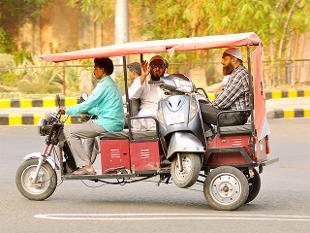
E-Rickshaw carrying Scooter and 3 persons – Now how many SUVs can do dat?
Farm Vehicle: For farm vehicle always use Indian breed bulls as the Jersey and HF bulls cannot be managed or trained and cannot work hard. Whereas the Indian Breed Bull (even without castration) is quite docile and willing to work hard.
If not a bull then an Electric Rickshaw is a must. It can be used as a small farmer’s tractor. The best thing about an electric rickshaw is that it does not require any license or permit to own and operate. You could use it as tractor replacement – to plough the fields or move your goods also use it to move goods of other people. Only if you are using the e-rickshaw to transport people you are bound by law to have a permit and license, but even this you could do relatively safely in interior parts of India. Above all to charge it you do not requre grid electricity you can place solar panels on the roof and charge on the go. 300W solar panels cost just Rs 14,000 good enough to recharge the vehicle daily even as the vehicle is being used.
Selling produce: Till today most Indian farmers’ responsibility used to be till the time he harvested. After that it is like somebody else’s job to buy it from him either by some wholesaler or the govt. But today with the advantages of Social media like Facebook, Twitter, Whatsup, YouTube, Instagram etc it has become far easier for the farmer to contact directly with the buyer.
The Farmer also can use the services of Online Retail Marts like Amazon, FlipKart and SnapDeal and many such online stores to provide direct to home services. If he wants he can create his own website or facebook page and get orders online. Using online services it is possible for a farmer in some remote villages to sell his ghee to far off city or some other country. He could even use courier services to transport it to nearby cities.
Moral of the story: The best way to farm is to combine the ancient method of farming and selling the produce in the modern high-tech method. Organic Zero Budget Natural Farming is the way to go (See Rajiv Dixit & Subash Palekar). Hydroponics can be innovated and used without air-conditioning and electricity and using traditional seeds and fertilizers and Green houses can be innovated to be made from bamboo and as rain/sun shelter rather than as a completely covered unit and also using traditional seeds and fertilizers We have to train ourselves to learn the ancient farming along with innovated modern methods and also learn the modern sales techniques.
============================================================================
The Transplanter & Jang seeder is a must have on your farms:
Check out below Youtube links to see how amazing it is.
Transplanter: https://www.youtube.com/watch?v=ULYCu6t5wm8
Jang Seeder: https://www.youtube.com/watch?v=4u0MtdFR9-I
Available cash-on-delivery from Amazon India both are worth every single paise:
Transplanter link: http://amzn.to/2tVmyor
Jang Seeder link http://amzn.to/2vUKcTD
 PlugInCaroo... Karo plugin... abhi!... save the environment!!!
Pingback: Free Agriculture Course Online | Free Online Farming Course | How to Farm ?| How to do farming ?| Farming for beginners | PlugInCaroo | PlugInCaroo… Karo plugin… abhi!… save the environment!!!
Pingback: How to do Zero Budget Natural Farming? | How to Farm | PlugInCaroo | PlugInCaroo… Karo plugin… abhi!… save the environment!!!
Pingback: How to Farm? | PlugInCaroo… Karo plugin… abhi!… save the environment!!!