
The Indian two-wheeler market has witnessed a significant shift in recent years, with petrol scooters experiencing a notable decline in sales especially in November-December 2024.
This trend is indicative of a broader movement towards sustainable and eco-friendly transportation solutions; signalling the end of the petrol (ICE) age in India.
HERO MOTOCORP SALES – 2024
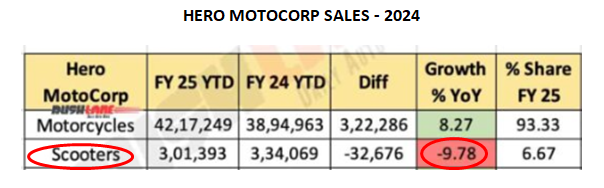
Hero MotoCorp, one of India’s leading…
two-wheeler manufacturers, reported a 9% year-on-year decline in scooter sales for December 2024.
BAJAJ AUTO SALES-2024 (almost half of exports)!!!
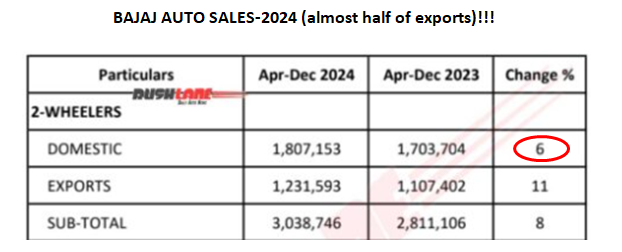
Bajaj Auto, another leading two-wheeler manufacturer, reported just a single digit percent increase (6% year-on-year) in 2Wheeler sales for December 2024. Its Export is almost as much as its domestic sale. The increase percent in domestic demand is almost half of the demand in export.
TVS SALES – 2024
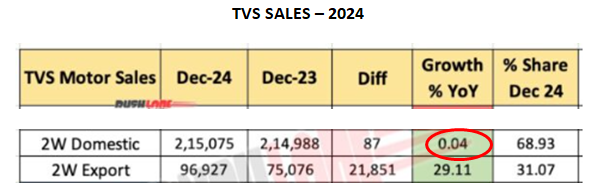
As for TVS the year-on-year increase percentage in sales is not even 1 percent.
These figures are shocking to say the least. These were companies which enjoyed double digit percent increase in year-on-year sales.
Their Sales Breakup show what the consumers want and what they don’t want:
Hero Motor Corp sales breakup:
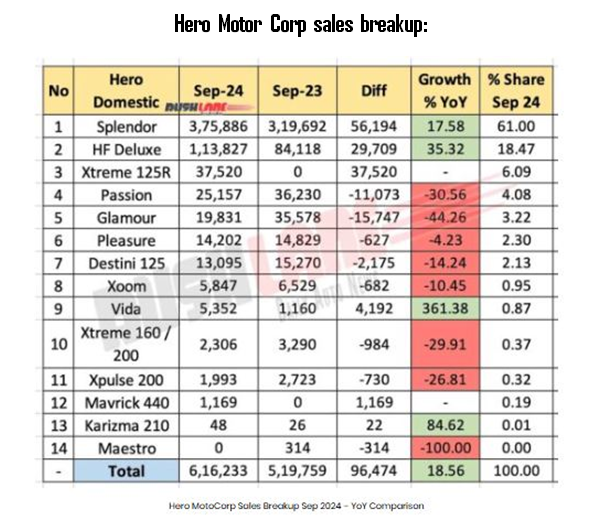
Of the fallen… Pleasure, XPulse, Xtreame and Maestro were popular models till late.
Bajaj Auto Sales Breakup:
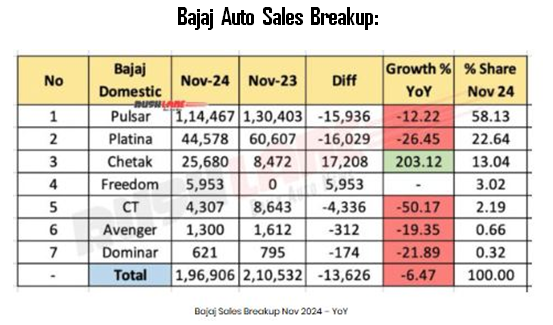
Of the fallen… Pulsar, Platina, Avenger and Dominar were very popular models till late.
TVS Sales Breakup:
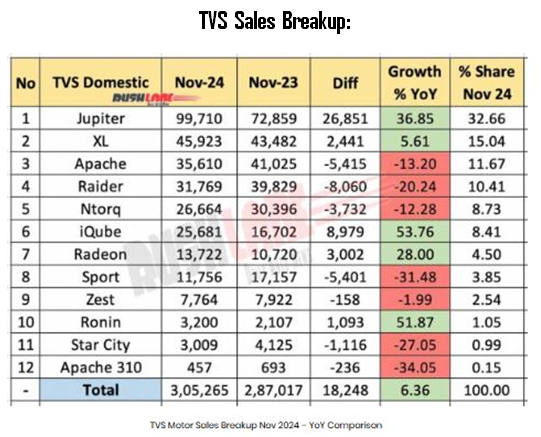
Of the fallen… Apache, Raider and Ntorq were very popular models till late.
The muted sale is part of a larger trend, while exports saw a rise. This is affecting scooter sales because of the aggressive growth of electric scooter sales of multiple companies. Electric Scooter Sales were the biggest growth stories of 2024.
- HeroMotorCorp eScooter (Vida) sales grew 361 %.
- Bajaj Auto eScooter (Chetak) sales grew 203 %.
- TVS eScooter (iQube) sales grew 53 %.
This shift in sales dynamics highlights the growing preference in India for electric vehicles (EVs) over traditional petrol scooters.
Several factors are driving the decline in petrol scooter sales and the rise of EVs in India:
- The price of petrol is always increasing irrespective of international crude oil prices.
- Increasing inflation is pressing people to increasingly reduce their transportation cost.
- Indian government has set ambitious targets to phase out fossil fuel vehicles by 2030. This policy push is aimed at reducing air pollution and greenhouse gas emissions, which are major contributors to climate change.
- The Indian govt also wants to reduce foreign exchange spent on crude oil import.
- The eScooters are becoming very affordable at cost price and almost zero refuelling cost. For eg: the latest Ola eScooter and eMotorcycle are available for Rs 75,000 (US$880) each. This is 20% cheaper than petrol scooters.
- Growing GigEconomy: Lots of QuickCommerce and food delivery companies are expanding in the top cities, tier-2 and even tier-3 cities in India. Using Electric Scooters especially the slow speed ones are very convenient for such businesses.
Impact on the Market
The shift towards electric scooters is reshaping the two-wheeler market in India. Traditional two-wheeler manufacturers are expanding their EV portfolios and launching new electric models to compete with startups in the EV space.
Companies like Honda Motorcycle & Scooter India (HMSI) and TVS Motor Co are investing heavily in EV technology and infrastructure. HMSI, for instance, plans to set up 500 battery swapping stations by March 2026.
But what is concerning is that none of these petrol scooter manufacturing companies feel the need to start manufacturing Lithium-Ion batteries in India.
Of these eScooter manufacturers only Ola Electric is manufacturing batteries in India.
The Battery manufacturing target of Ola GigaFactory is 100GWH which is almost 3 times the combined capacity of the planned output of Exide and Amara Raja Li-Ion plant cell.
So by Dec 2025 there could become such a situation that HeroMotorCorp, Bajaj Auto and TVS might have to buy batteries from Ola Electric, because Ola’s battery being made in India would be the most cost effective.
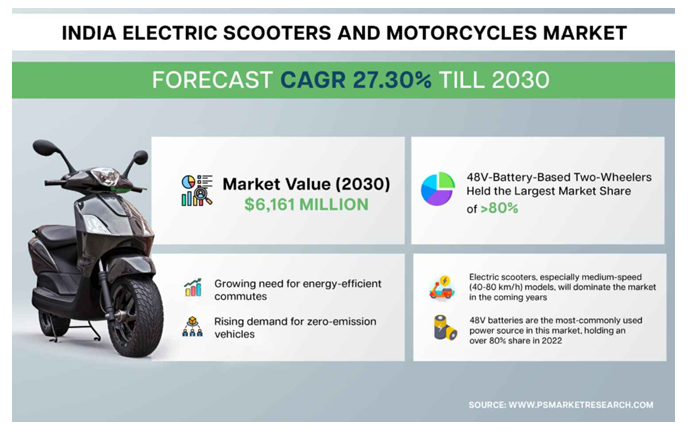
Future Outlook
The future of the two-wheeler market in India looks promising for electric vehicles. With the government’s support and increasing consumer demand, EVs are expected to dominate the market in the coming years.
The transition to electric scooters will not only help reduce pollution but also create new job opportunities and drive economic growth.
In conclusion, the decline in petrol scooter sales and the rise of electric vehicles could mark the end of the petrol (ICE) age in India.
This shift is driven by government policies, technological advancements, and changing consumer preferences.
As India moves towards a greener future, the two-wheeler market will continue to evolve, with electric scooters leading the way.
 PlugInCaroo... Karo plugin... abhi!... save the environment!!!