
In the rapidly evolving electric vehicle landscape of India, accurate reporting is not just a matter of numbers—it shapes public perception, investor confidence, and policy direction.
Yet, June 2025 witnessed a striking example of how selective data interpretation and misreporting can distort the narrative.
Two of the country’s leading EV manufacturers, Ola Electric and TVS Motor Company, found themselves at the center of conflicting sales reports that merit closer scrutiny.

Lets analyze more:
Several media outlets reported that Ola Electric’s sales had “plummeted” in June 2025, citing a 45% year-on-year decline compared to June 2024.
While this statistic is factually correct, it omits a crucial detail: Ola Electric actually registered a 9% increase in sales compared to May 2025, signaling a potential turnaround after months of decline.
According to VAHAN data, Ola sold 20,189 units in June, up from 18,499 in May.
This sequential growth, though modest, marked the first positive month-on-month movement in three months and suggested early signs of stabilization.
By focusing solely on the year-on-year drop, many reports failed to acknowledge the broader context—namely, that Ola’s sales had been in a downward spiral and that June’s uptick could indicate the beginning of a recovery.
This omission not only misrepresented the company’s current trajectory but also potentially misled stakeholders about its operational momentum.
TVS Motor: A Tale of Two Figures

In contrast, TVS Motor Company was widely celebrated in the media for leading the electric two-wheeler market in June 2025, with reports claiming it sold over 25,000 electric scooters.
Below is TVS June Sales are reported to SEBI:
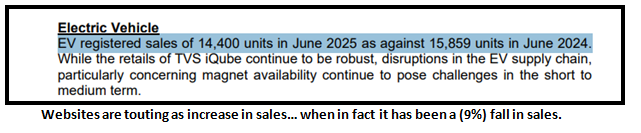
While this figure (25,000+) aligns with VAHAN registration data, it appears to COMPLETELY conflict with TVS SEBI filing, which reported just 14,400 electric vehicle sales for the month.

This discrepancy raises important questions about the difference between vehicle registrations and actual deliveries or sales. VAHAN data reflects registrations, which may include vehicles in transit, dealer stock, or even pre-registered units… OR… is there a “PAID AGENT” manipulating Vahan Data? After all a difference of above 11,000 vehicles per month is way too much.
In contrast, SEBI filings are legally binding disclosures that reflect actual sales recognized by the company. If TVS reported only 14,400 EV sales in its SEBI filing, then the higher figure cited in media reports may overstate the company’s real market performance.
Previously Ola was pulled up by SEBI for Ola’s Vahan vs Actual sales mismatch during their issue with Rosmerta… Is SEBI going to pull up TVS also?
Bajaj Auto: An Opaque Picture
Adding to the lack of clarity, Bajaj Auto has not disclosed (till the time of writing) model-wise sales figures for its electric line up, including the Chetak, for June 2025.
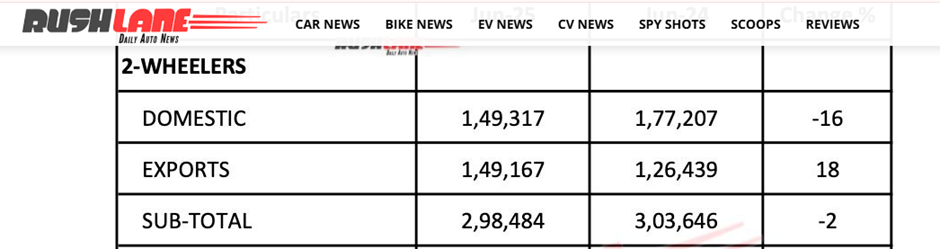
Bajaj Auto… Domestic 2Wheeler sales fell by 16% … exports increased by 18%… yet total YoY sales fell by 2%.
While its total two-wheeler sales stood at 2,98,484 units, there is no public breakdown of how many of those were electric scooters.
Yet the websites had no shame in declaring Bajaj Auto as the 2nd Runner Up. From where did they get Chetak sales figures for June 2025?
This absence of transparency makes it difficult for analysts and consumers to evaluate Chetak’s exact market performance, especially amid rising competition in the EV segment.
The Broader Implications
These inconsistencies highlight a growing challenge in the EV sector: the lack of standardized, transparent, and consistently interpreted data.
When media outlets selectively emphasize certain metrics—such as year-on-year declines for one company and registration highs for another—they risk creating a skewed narrative that favors one player over another.

Moreover, such reporting can have tangible consequences:
- Investors may make decisions based on incomplete information.
- Consumers may be swayed by perceived popularity.
- Policymakers may misjudge the effectiveness of subsidies or regulations.
In a sector as nascent and strategically important as electric mobility, these distortions can ripple far beyond the headlines.

Conclusion
As India accelerates toward an electric future, the need for responsible journalism and data literacy becomes paramount.
Ola Electric’s 9% month-on-month growth in June 2025 deserved recognition as a sign of resilience, not dismissal.
Similarly, TVS’s actual EV sales, as disclosed in its SEBI filing, should be the benchmark for evaluating its performance—not inflated registration figures.
And until Bajaj Auto provides greater clarity on its Chetak sales, its EV standing remains speculative at best.
In the end, numbers tell a story—but only when they’re told in full.
 PlugInCaroo... Karo plugin... abhi!... save the environment!!!