
India’s electric mobility sector is undergoing a rapid transformation, with several manufacturers introducing innovative two-wheelers that cater to diverse consumer needs.
Among the most notable players are Ultraviolette, Ather Energy, Hero MotoCorp (Vida), River, and Ola Electric. Each brand positions its products differently, balancing affordability, performance, range, and convenience.
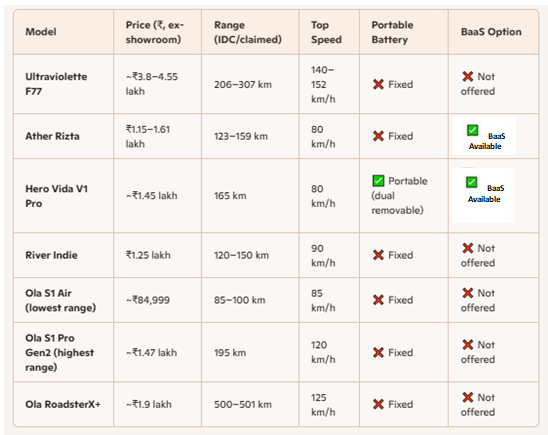
A comparative look at their offerings—Ultraviolette F77, Ather Rizta, Hero Vida V1 Pro, River Indie, Ola’s S1 Air and S1 Pro, and the ambitious Ola RoadsterX+—reveals the strengths and trade-offs shaping India’s EV adoption story. Rizta & Vida are available with BaaS option.
What is BaaS?:
Performance and Premium Appeal
Ultraviolette’s F77 stands out as a performance-oriented electric motorcycle. With a top speed exceeding 150 km/h and a range of up to 307 km, it appeals to enthusiasts seeking speed and long-distance capability. However, its premium price tag of ₹3.8–4.55 lakh places it in a niche category, accessible mainly to riders who prioritize cutting-edge technology and performance over affordability.
Similarly, Ola’s RoadsterX+, priced at around ₹1.9 lakh, promises an extraordinary 500 km range and 125 km/h top speed, positioning itself as a futuristic commuter and touring option. These models symbolize the aspirational side of India’s EV market.
Urban Commuter Choices
For city riders, Ather Rizta and River Indie strike a balance between practicality and affordability. The Rizta, priced between ₹1.15–1.61 lakh, offers a range of 123–159 km and a top speed of 80 km/h, ideal for daily commuting. River Indie, at ₹1.25 lakh, provides 120–150 km range and 90 km/h speed, with a utility-focused design that emphasizes storage and comfort. Both scooters are tailored for urban families and professionals who value reliability and convenience.
Charging Flexibility and Innovation
Among the lineup, Hero Vida V1 Pro stands out for its portable battery system. Priced around ₹1.45 lakh, it offers a 165 km range and 80 km/h top speed, but its removable dual battery makes charging at home or office far more convenient.
This feature addresses one of the biggest challenges in EV adoption— lack of charging infrastructure. In most residences and high rises the housing society management is reluctant to allow EV owners to install their own charging sockets in the building parking area. Portable batteries gives riders flexibility and control… allowing them to carry the battery to their house to charge them.
Hero Vida is the lone top scooter maker providing portable battery. It provides 2 swapable batteries. so you can have one charging at home while you use the 2nd battery.
Entry-Level Affordability
For budget-conscious buyers, Ola S1 Air is the most accessible option at ₹84,999. With a modest range of 85–100 km and a top speed of 85 km/h, it is designed for short commutes and first-time EV adopters.
On the other hand, Ola’s S1 Pro Gen2, priced at ₹1.47 lakh, offers nearly double the range (195 km) and a higher top speed of 120 km/h, making it a strong contender in the mid-range commuter segment.
Conclusion:
The best electric 2-wheelers from India reflect the diversity of consumer needs:
- Ultraviolette F77 and Ola RoadsterX+ for performance and long-distance touring.
- Ather Rizta and River Indie for urban practicality.
- Hero Vida V1 Pro for charging flexibility with its portable battery.
- Ola S1 Air and S1 Pro for affordability and balanced commuting.
Together, these models showcase India’s rapid progress in electric mobility, offering choices that empower riders to embrace sustainable transport without compromising on speed, range, or convenience.

