
Lithium Cell Manufacturing Status & Price Comparison (India vs China, 2026)
Key Takeaways
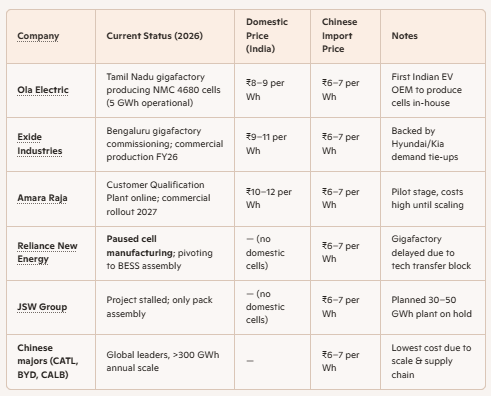
- Ola Electric is the only Indian EV OEM already producing cells, though at higher cost than Chinese imports.
- Exide & Amara Raja are in early stages, with costs ~30–50% above Chinese benchmarks.
- Reliance & JSW have no domestic cell output — Reliance pivoted to energy storage systems, JSW is stuck without a tech partner.
- China’s dominance continues, with CATL and BYD setting the global low‑cost benchmark.
India’s drive to manufacture lithium cells domestically is about national security, economic independence, and technological resilience.

- Energy security: Batteries are critical for EVs, renewable energy storage, and defense. Relying on imports from China risks supply disruptions.
- Geopolitical risk: India and China have unresolved border disputes (Ladakh, Arunachal Pradesh). China also supports Pakistan militarily and diplomatically. In a conflict scenario, China could cut off battery exports, crippling India’s EV and energy sectors.
- Strategic autonomy: Domestic production aligns with Atmanirbhar Bharat, ensuring India controls its own critical technologies.
- Job creation: Gigafactories generate thousands of skilled jobs, strengthening India’s industrial base.
- Technology development: Building expertise in cell chemistry, recycling, and pack integration positions India for long‑term competitiveness.
Cost Dynamics: India vs China
- Chinese cells: ₹6–7 per Wh (CATL, BYD, CALB).
- Indian cells (2026):
- Ola Electric: ₹8–9 per Wh
- Exide: ₹9–11 per Wh
- Amara Raja: ₹10–12 per Wh
The gap exists because Chinese firms operate at massive scale (>300 GWh), while Indian plants are still in early phases.
Shipping, Tariffs & Strategic Costs
Even if Chinese cells are cheaper at source, landed costs in India are higher:
- Shipping costs: Transporting hazardous lithium cells adds logistics overhead.
- Tariffs & duties: India can impose protective tariffs to encourage domestic production.
- Geopolitical leverage: China could weaponize supply chains during conflict, cutting off exports.
Thus, the true cost of dependence on China is not just financial — it’s strategic vulnerability.
Future Outlook: Ola Electric’s Timeline
- Ola Electric expects its Tamil Nadu gigafactory (5 GWh NMC cells) to reach cost parity with Chinese imports by 2027–28, once production scales and supply chain localization improves.
- Exide & Amara Raja also project costs falling to ₹7–8 per Wh by 2027–28, approaching Chinese levels.
- With PLI subsidies + tariff protection, Indian cells could even become cheaper than imports in the domestic market, though China will likely remain the global low‑cost leader.
Conclusion
India’s lithium cell push is about national resilience in the face of geopolitical rivalry. Depending on China — a country with which India has border disputes and which supports Pakistan militarily — for critical battery supplies is strategically dangerous.
Domestic manufacturing ensures India can power its EV revolution, renewable energy storage, and defense systems without fear of supply disruption.
While Indian cells are costlier today, scaling, subsidies, and tariffs will narrow the gap. By 2027–28, Ola Electric, Exide, and Amara Raja expect to reach cost parity with Chinese imports, securing both economic competitiveness and national security.

