
As India’s festive season begin with Navratri traditionally considered an auspicious time to buy Vehicles, Gold, Silver and Real Estate.
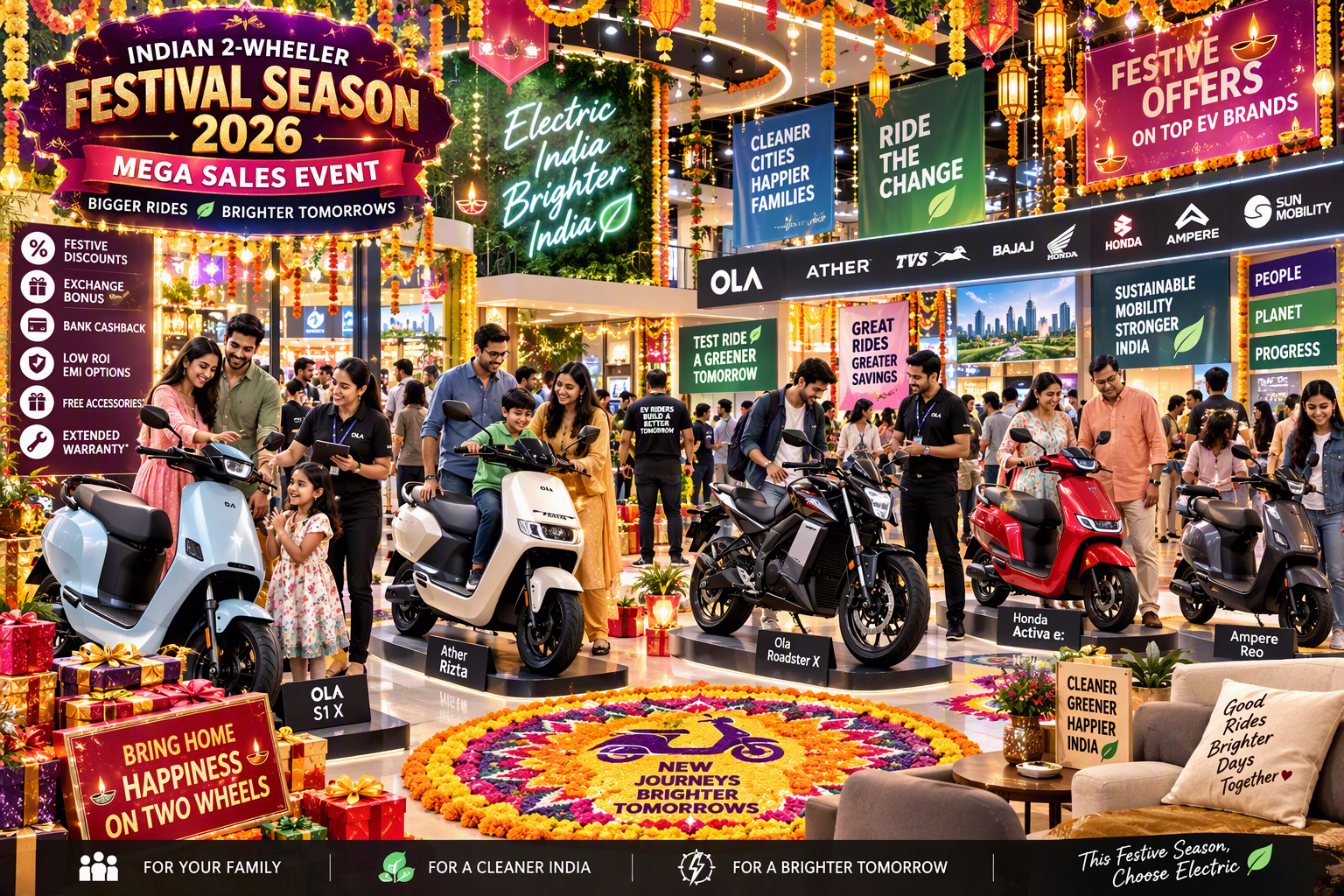
The familiar rumble of internal combustion engines at local dealerships is increasingly being replaced by the high-tech hum of electric two-wheelers (e-2Ws).
Driven by surging public charging networks, a maturation of vehicle build quality, and a profound shift toward cost efficiency, monthly electric two-wheeler sales in India have comfortably breached the historic milestone of 2 lakh units.
This festive period represents a critical inflection point where electric mobility has shifted from a novelty for early adopters to the mainstream choice for the everyday Indian family.
The 2026 electric two-wheeler market presents a fascinating study in diversity. The industry has bifurcated into two distinct philosophies:
- High-capacity fixed-battery performance, and
- Ultra-convenient modular swapping networks.
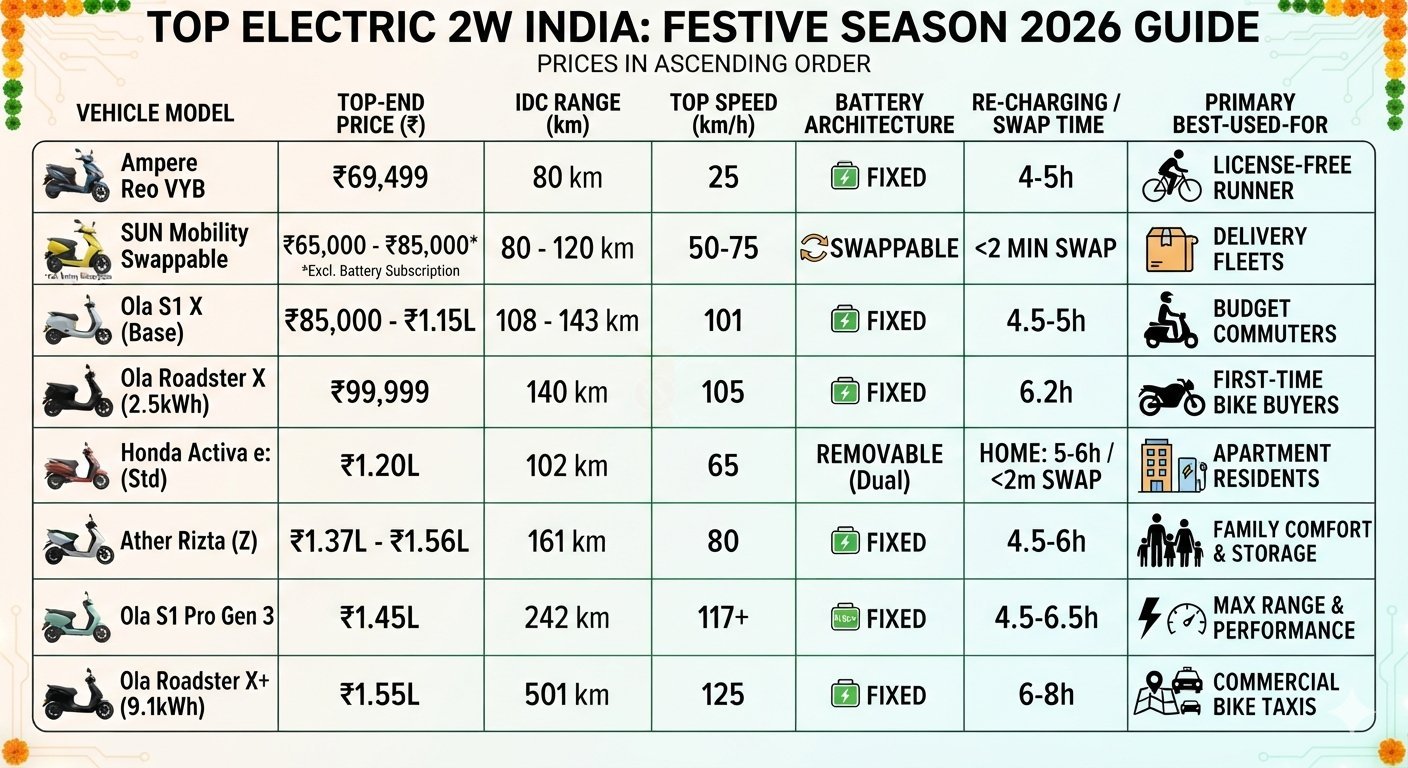
For buyers looking for long-term ownership stability, tech-driven engineering firms like Ather Energy have reinvented the classic family scooter. The Ather Rizta, with its focus on class-leading storage space and a massive seat, captures the traditional family buyer who values safety, comfort, and sophisticated software integration over raw speed.
Concurrently, Ola Electric continues to push the boundaries of pure utility and tech specifications. Catering to every segment of the socioeconomic ladder, Ola offers the stripped-down, highly affordable Ola S1 X for short-distance neighborhood runs, alongside the hyper-premium Ola S1 Pro Gen 3, which boasts a staggering true-to-life range of up to 180 kilometers.
Furthermore, Ola’s entry into the motorcycle segment with the Roadster X has brought electric performance to traditional motorcycle frames. Most notably, their flagship 9.1 kWh Roadster variant—boasting a massive 500-kilometer Indian Driving Cycle (IDC) range—has become the premier choice for the high-end commercial market, providing an ideal workhorse for delivery networks and bike taxis that require continuous uptime.
Although Ather’s Konarc comes with a lot of cool features never seen before in 2wheelers the full option Konarc is still to hit the market. The Ola Z Series has the best value for money and comes combined with portable LFP battery pack.
For the budget-conscious household, traditional entry-level runners like the Ampere Reo offer an elegant solution, bypassing vehicle registration requirements entirely for low-speed city errands.
The most profound evolution of the 2026 festive season, however, lies in the liberation of the consumer from “battery anxiety.” Legacy automotive pioneer Honda has entered the fray with the Honda Activa e:, cleverly adapting India’s most trusted scooter nameplate to house dual removable battery modules. This allows urban flat residents to carry batteries directly to their living rooms for charging, or utilize Honda’s rapidly growing corporate swapping stations.
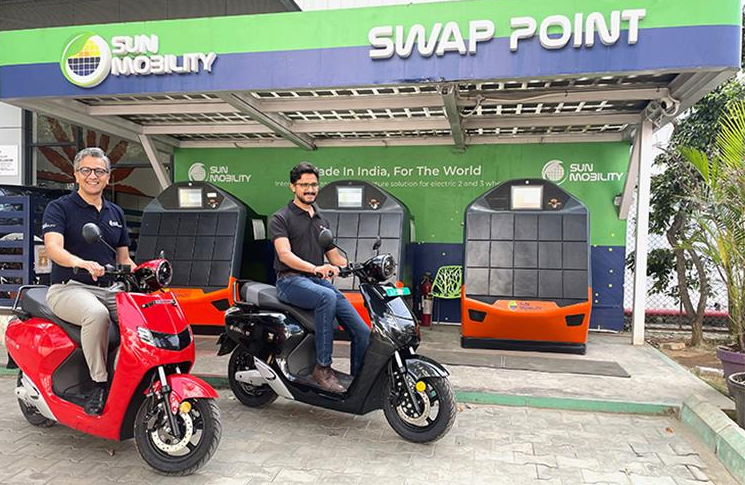
Taking this liberation a step further is the meteoric rise of the open-architecture Battery-as-a-Service (BaaS) network, spearheaded by giants like SUN Mobility (operating through its Indofast Energy joint venture with Indian Oil).
Brands like Ampere, Bounce Infinity and e-Sprinto, are trying to shifts the ownership paradigm, make just scooters while the battery part will be taken care of by Sun Mobility.
SUN Mobility partners with scooter companies to design or modify their electric scooters so they are built to house SUN Mobility’s modular, swappable lithium-ion batteries.
Buyers are no longer obligated to purchase the expensive battery pack up front—reducing the scooter’s initial retail price by up to 40 percent. Instead, users simply subscribe to a swapping plan.
Commercial riders can pull into an automated kiosk at a local fuel station, exchange a depleted battery for a fully charged one in under 2 minutes, and eliminate all fears regarding long-term battery degradation or out-of-warranty replacement costs.
As the festive lights illuminate markets across India, the choice of a two-wheeler has evolved beyond aesthetics and fuel economy.
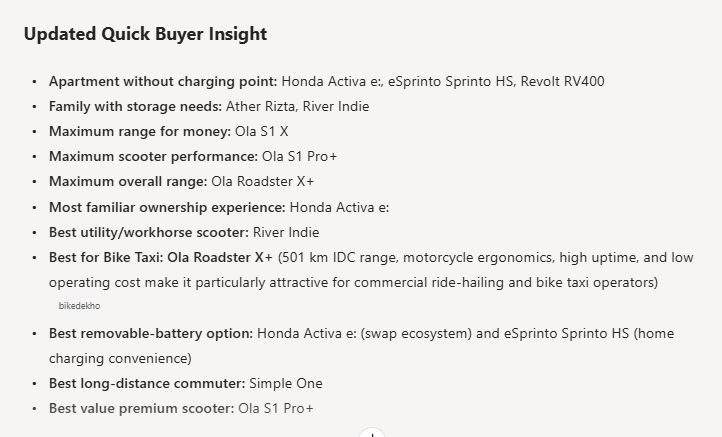
Ather had earlier enabled BaaS financing for Rizta eScooter where customers did not pay the price of the battery at the time of the purchase and paid the price of the battery through another EMI. So people did not have to worry about the most expensive part of the eScooter.
eScooters today has become a choice between the seamless, premium convenience of an Ather Rizta, the raw range dominance of an Ola Roadster, or the zero-downtime flexibility of a SUN Mobility-powered swappable battery vehicles.
With robust manufacturer discounts, immediate fuel savings, and an infrastructure capable of supporting both personal commutes and intense commercial logistics, the 2026 festive season establishes electric two-wheelers not just as the future of Indian transport, but as the undeniable present.

