
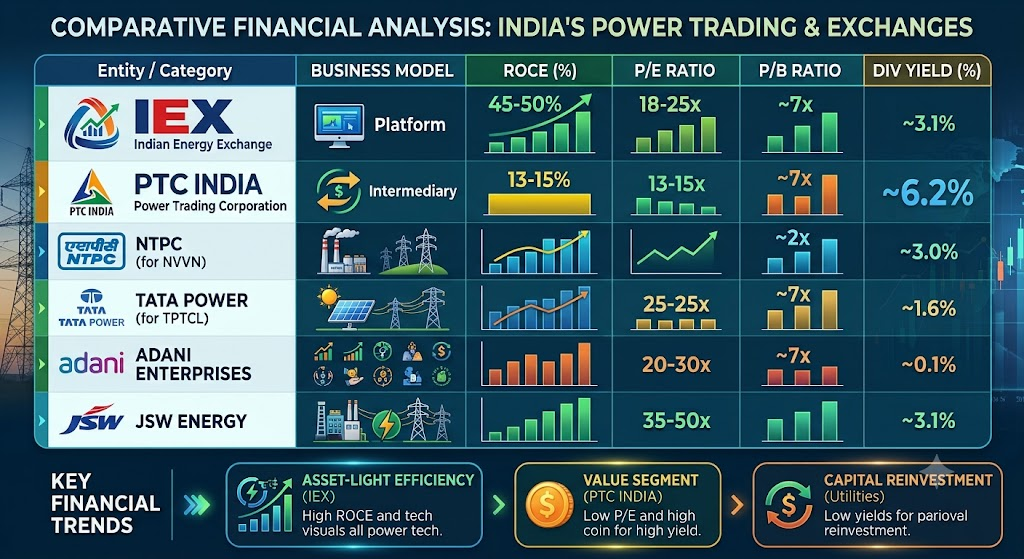
Key Takeaways by Metric
1. Return on Capital Employed (ROCE)
- High-Efficiency Winner (IEX): Indian Energy Exchange delivers exceptionally high ROCE (often near 50%) because it operates as an asset-light tech platform. It requires minimal physical capital or debt to generate revenues.
- Pure Trading (PTC India): Delivers a solid ROCE of ~13–15%, outperforming traditional power producers because trading margins require working capital rather than expensive power plant setups.
- Integrated Utilities (NTPC, Tata Power): Show lower overall ROCE (7–9%) due to massive capital expenditure tied up in physical generation plants, transmission lines, and distribution networks.
2. Price-to-Earnings (P/E) & Valuation
- Discount / Value Segment: PTC India trades at a low single-digit P/E (~8x), reflecting lower top-line growth expectations and narrow trading margins per kWh.
- Growth / Moat Segment: IEX commands a moderate-to-high valuation given its dominant exchange market share and asset-light margins. Conglomerates like Adani Enterprises trade at high multiples driven by broader business incubation rather than pure power trading.
3. Price-to-Book (P/B) Ratio
- PTC India trades below its book value (P/B < 1.0), offering a value profile.
- IEX trades at a high P/B (> 6.5x) because its primary assets are technology infrastructure, clearing systems, and network effects rather than physical property.
4. Dividend Yield
- Income Play (PTC India): Offers a high dividend yield (~6%+), making it attractive to dividend-focused portfolios.
- Balanced Yield (IEX & NTPC): Generate steady cash flows and maintain reasonable dividend yields of ~2.8% to 3.3%.
- Reinvestment Play (Tata Power, Adani, JSW): Retain most earnings to fund aggressive renewable capacity expansion and capital expenditures, resulting in lower dividend yields (< 1%).
PTC applies for Mineral Trading:
- Mineral Exchange Platform: In late October 2026, PTC India’s Board of Directors approved an equity investment of up to ₹65 crore to set up a wholly-owned subsidiary as a Special Purpose Vehicle (SPV).
- Business Scope: The new entity will establish and operate an electronic Mineral Exchange in India under the Mineral Exchange Rules, 2026. It will facilitate delivery-based spot trading, transparent price discovery, and market-based supply contracts for permissible minerals.
- Regulatory Application: The Indian Bureau of Mines (IBM) invited applications to operate mineral exchanges, and PTC India submitted its application to register as an exchange operator.
This move represents a major strategic diversification for PTC India beyond electricity trading, applying its expertise as an energy exchange pioneer to physical commodity and mineral market infrastructure.

