
The global transition toward sustainable urban transportation has forced automotive giants to radically reimagine their long-term product portfolios.
Among these legacy players, Honda Motor Company occupies a unique position. As an undisputed leader in the internal combustion engine (ICE) two-wheeler market, Honda’s pivot to electric mobility represents not just a corporate transition, but a tectonic shift for urban commuting.
Rather than rushing to market with a single compromise solution, Honda has executed a meticulously bifurcated strategy, targeting two distinct consumer demographics: the premium personal commuter and the high-utility commercial operator.
A Bifurcated Product Lineup: Activa e: and QC1
At the center of Honda’s electrification strategy are two distinct models designed from the ground up for entirely separate use cases.
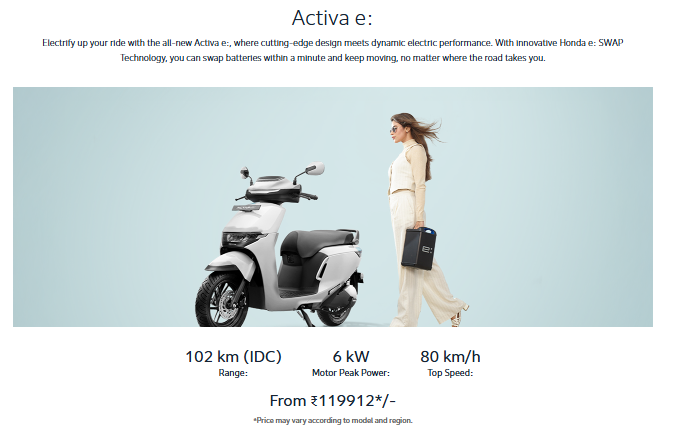
For the mainstream retail buyer, Honda introduced the Activa e:. This premium electric scooter carries the heavy responsibility of translating India’s most trusted scooter moniker into the zero-emission era.
Architected for personal daily transit, the Activa e: relies on a high-voltage powertrain and an advanced feature set designed to match or exceed its petrol counterpart’s capabilities.
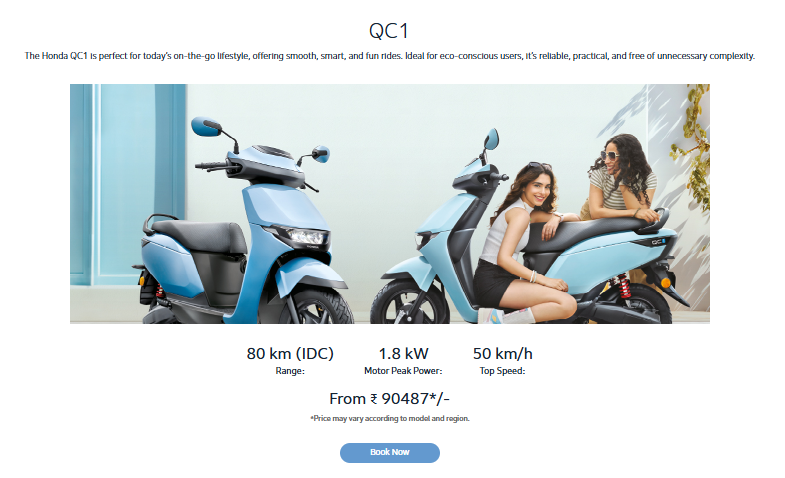
Conversely, the Honda QC1 represents a specialized approach to commercial fleet management and the rapidly growing gig economy.
Designed as an affordable, ultra-durable urban runabout, the QC1 strips away premium luxuries in favor of utility, structural resilience, and low operational overhead.
The QC1 serves delivery agents and logistics platforms operating over tightly constrained, predictable daily rides.
While other manufacturers provide swapable batteries to the gig-economy or the delivery boys or the commercial vehicles Honda has for some strange reason allocated the non-portable batteries to its commercial vehicle – QC1.
What is sure is thst Honda seems to have donenits market study very well. This jump into eScootees was not sudden kneejerk but seems to have been properly analysed… Time will tell if it was the correct decision.
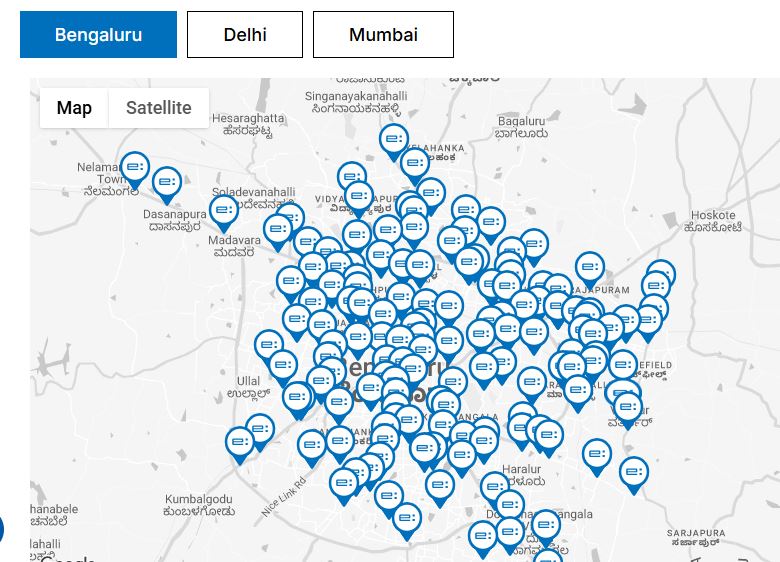
But what is very apparant is that Honda has been installing Honda battery swap stations at HPCL Petrol Pump, near Metro stations and other areas of Bengaluru.
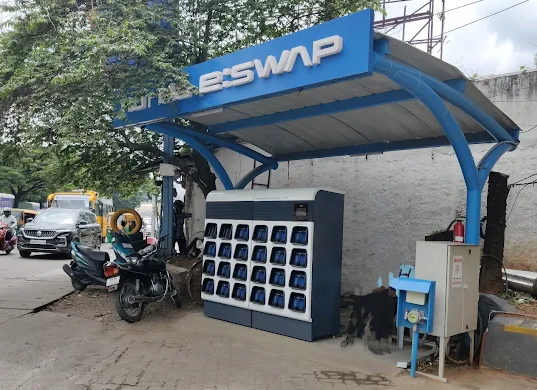
Honda, as of today, is the ONLY big eScooter maker with the most swap stations. Atul Greentech Pvt Ltd (subsidiary of Auto Auto) is the only other company sharing this Swap battery of Honda.
Hero MotorCorp has swapable VIDA scooter but not much swap stations are visible. Vida battery is more like a take it home to charge than swap.
| Specification Element | Honda Activa e: (Premium / Personal) | Honda QC1 (Utility / Commercial) |
| Battery Architecture | Dual Swappable (Honda Mobile Power Pack e:) | Fixed Internal Pack |
| Total Energy Capacity | 3.0 kWh (2 × 1.5 kWh units) | Optimized Fleet Pack |
| Powertrain Motor | 6 kW Permanent Magnet Synchronous Motor | High-Efficiency Hub/Mid Motor |
| Peak Torque | 22 Nm | Optimized for urban loads |
| Maximum Speed | 80 km/h | 50 km/h |
| Acceleration | 0 → 60 km/h in 7.3 seconds | 0 → 40 km/h in 9.7 seconds |
| Certified IDC Range | 102 km per cycle | 80 km per cycle |
| Premium Instrumentation | 7-inch Dynamic TFT display, RoadSync Duo® | High-Durability Minimalist LCD |
Analysis of Early Market Performance
Understanding Honda’s market position requires contextualizing its recent sales data within an early, highly controlled operational expansion phase.
Over the last five months, retail tracking across registration networks reveals a total volume of 1,574 electric units. While this total may appear modest relative to established electric incumbents, a sequential month-on-month examination reveals a deliberate production scale-up.
This acceleration culminated recently with monthly registration figures successfully eclipsing the critical 500-unit milestone for the first time, finalizing at 520 units in the most recent month.
This deliberate rollout highlights a conservative market entry strategy. Rather than risking widespread quality issues or creating a mismatch between vehicle sales and infrastructure availability, Honda has constrained initial volumes to match its localized physical footprint.
(this was the thing that Ola Electric did not do… slow scaling up in initial stages… a mistake that took an entire year to rectify).
This measured approach of Honda mirrors its historic product introductions—prioritizing absolute manufacturing fidelity and system stability over rapid market share accumulation.
The Infrastructure Paradigm: A Dual-Engine Approach
The core question facing electric two-wheeler manufacturers centers on energy replenishment: should resources be allocated toward swappable battery networks or static plug-in charging networks?
Honda’s response is an elegant, dual-engine ecosystem that refuses to treat these technologies as mutually exclusive. Instead, infrastructure development directly follows the architectural needs of its vehicle lineup.
For the personal commuter driving the Activa e:, Honda is aggressively building out its proprietary Honda e: SWAP station network. This model addresses consumer range anxiety and the logistical constraints of urban apartment dwellers who lack private garage charging facilities.
By utilizing a subscription framework, riders can exchange depleted modular units for fully charged ones in less time than it takes to fuel a traditional ICE vehicle. This system drastically minimizes vehicle downtime and shifts the burden of battery depreciation off the consumer’s shoulders.
Simultaneously, Honda is leveraging its existing, massive legacy dealership footprint to install plug-in charging stations. This infrastructure serves a critical dual purpose.
First, it offers a reliable depot-charging anchor for commercial QC1 fleets requiring stable overnight or mid-day stationary charging.
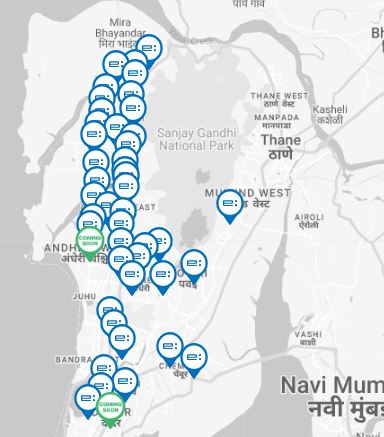
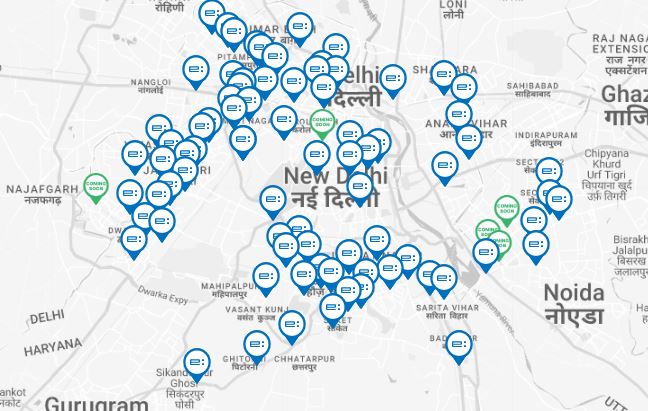
Second, it serves as an emergency fallback safety net for Activa e: owners who find themselves outside the immediate grid of automated swapping kiosks. By avoiding single-technology dogmatism, Honda ensures structural resilience across both retail and corporate logistics segments.
Conclusion
Honda’s blueprint for electric mobility serves as a compelling case study in balanced industrial transition. Through a product family split cleanly between personal refinement and commercial utility, a production line scaling systematically alongside physical infrastructure, and an energy strategy that harmonizes rapid battery swapping with universal plug-in charging, Honda is building a highly sustainable ecosystem.
The automotive giant’s patient, infrastructure-first playbook indicates that while it may not have been the first to enter the electric arena, its foundational architecture is built to endure.

