
Over the past twenty years, wealth building across India’s major asset classes has been defined by a wide gap between steady preservation and high-octane compounding.
While traditional anchors like bank fixed deposits and residential real estate delivered single-digit price growth, precious metals—and select individual equities—showed how compounding, rupee depreciation, and corporate actions reshape long-term outcomes.
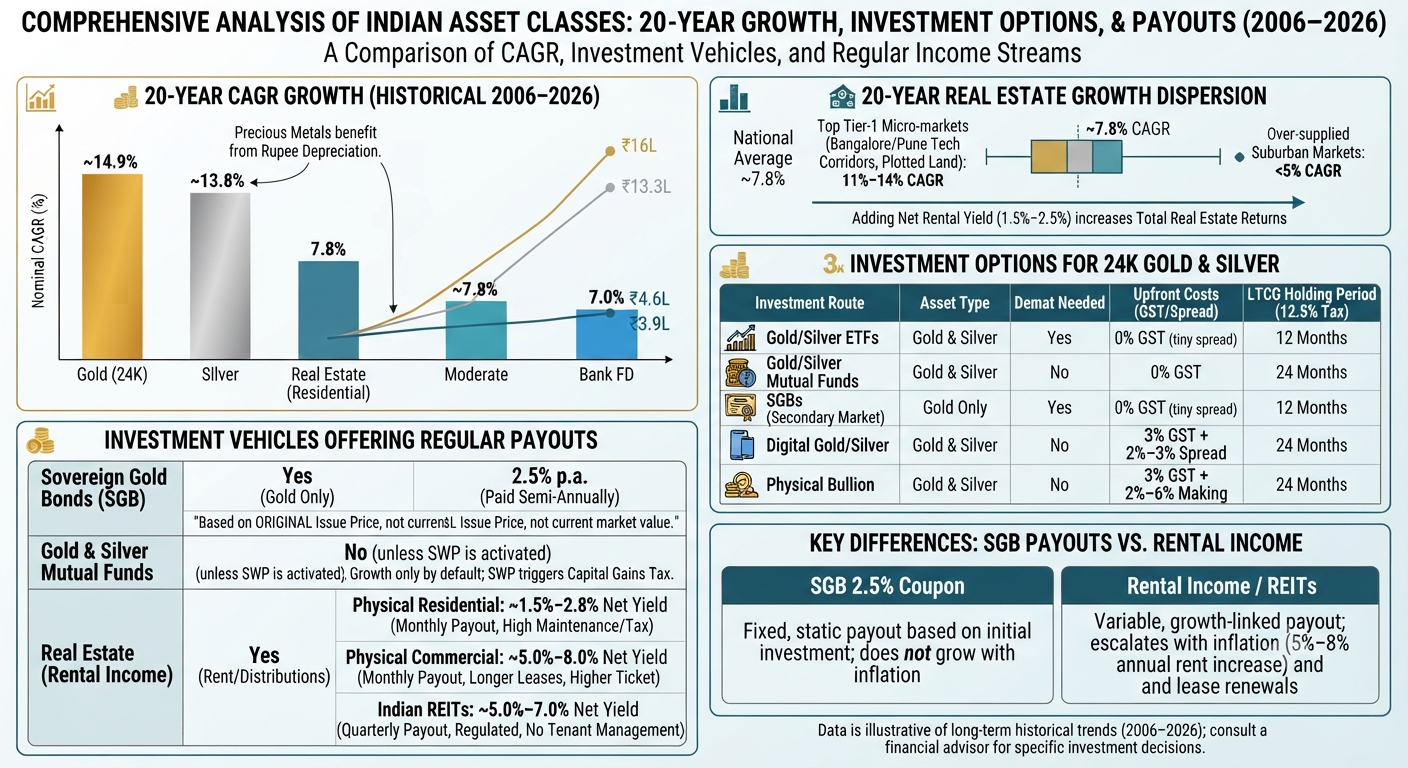
At the conservative end of the spectrum, Bank Fixed Deposits and Residential Real Estate have generally compounded near ~6.5%–7.5% and ~7.5%–8.5% per year, respectively.
But if you need Qtrly or mthly payouts the interest rates are lower.
Bank FDs offer predictability and liquidity, yet annual slab taxation erodes real purchasing power for higher-tax-bracket savers.
Real estates has been considered as the WORST INVESTMENT option because: it costs a bomb… most of the decent RENT-fetching properties are above 1Cr… taking a 1 Cr loan to buy the property completely negates the income…and actually bkrders on becoming a liability… unless you have 1 Cr in bank.
Also renting the property out is absolutely not a passive income… comes with its own headache of regularly finding new people… ensuring not to keep the existing customer more than 3yrs… else he becomes too attached to the property to vacate… you need to be be rude to customers who try to not to give in to annual 5% increase… so there has to be regular monitoring to be done… and a close eye has to be kept on property… and ofcourse you need to kick out that person who tries paying rent altogether due to job loss or being a conman… so you need to be juggling.
REITS is a good solution to all the headaches in Real Estate… you can get in buying small lots of its shares… yet get all the benefits of owning a real estate property.
Residential real estate adds potential rental income—ranging from modest net residential yields to stronger commercial and REIT distributions—but remains heavily location-dependent, illiquid, and subject to maintenance, vacancy, and transaction frictions.
24K Gold… and Silver occupied a middle ground over the two-decade period, compounding roughly in the ~13.5%–15.3% range.
Their domestic returns reflected both global bullion cycles and the long-term depreciation of the Indian rupee against the US dollar.
Investors today can access them through exchange-traded funds, mutual funds and secondary-market (Demat Account).
Sovereign Gold Bonds (the only route paying a fixed 2.5% annual coupon on the original issue price), digital bullion, or physical coins and bars—each carrying distinct cost, liquidity, and tax trade-offs.
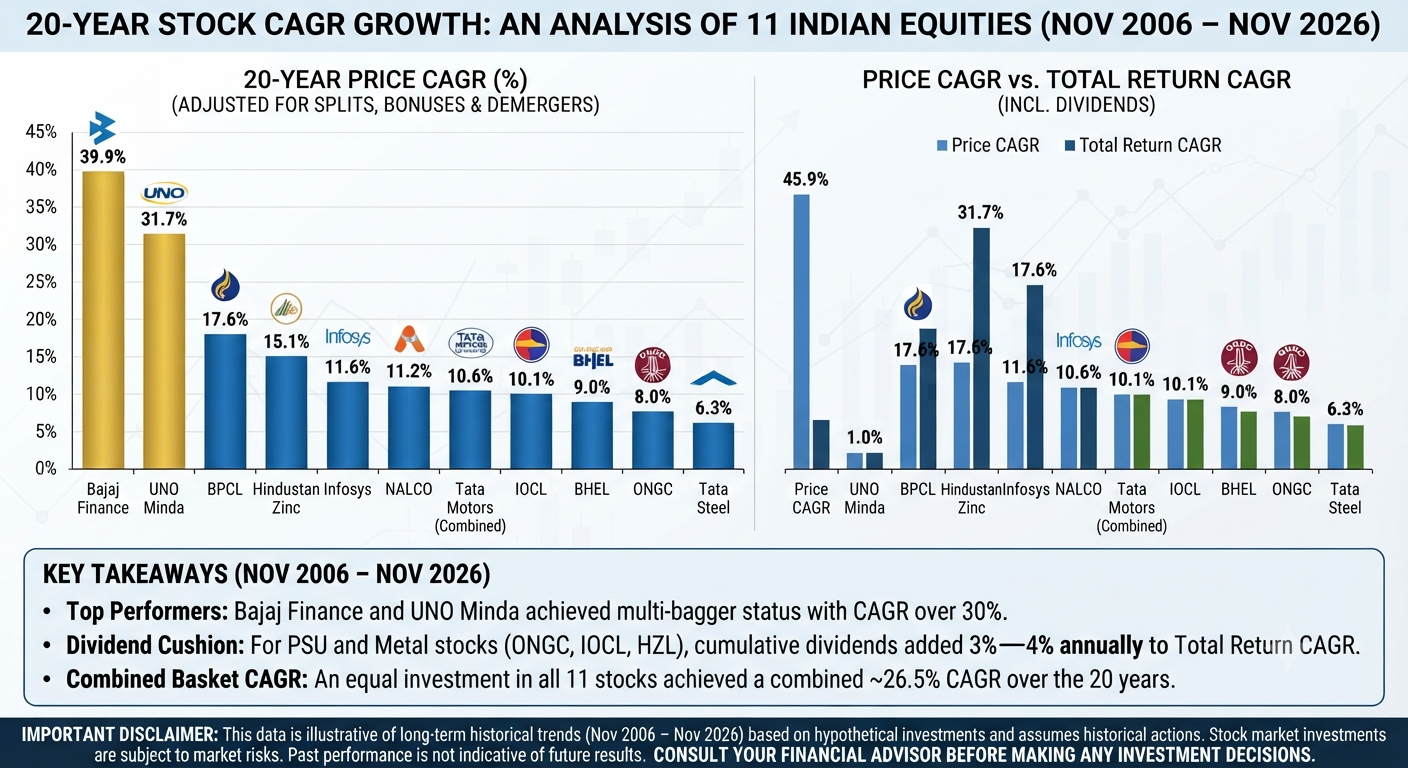
Individual Indian Equities, meanwhile, illustrated both extreme dispersion and the power of long-term corporate compounding.
Across the eleven stocks examined, twenty-year price CAGRs ranged from ~6.3% in cyclical steel to over ~31%–39% in standout compounders like UNO Minda and Bajaj Finance, aided by stock splits, bonus issues, and demergers. Equally important, cash dividends provided a meaningful cushion in high-payout PSU and commodity names, lifting total returns noticeably above price growth alone.
Stocks also give periodically (qtrly) dividends. Advantage of stocks is your principle gets multiplied whenever you get a BONUS or Stock Split… in all other asset class… what qty you buy you stay with that.
In stocks if you bought 2,000 shares each costing Rs100… getting 1% div over 20 yrs would be something like 1,28,000 shares (assuming 6 round of a 1:1 bonus) and still get min 1% dividend… and the price of each share will be like Rs 1,000 per share… which GREATLY increases your wealth.
Taken together, no single asset class dominates every environment: fixed income stabilizes cash flow, real estate and gold hedge inflation and currency drift, and equities drive long-term growth alongside volatility.
Spreading your investment across these seem to be the safest bet.
Balancing these roles around your time horizon, cash-flow needs, and tax profile—ideally with guidance from a qualified financial advisor—remains central to sustainable wealth creation.

