
The Indian electric vehicle (EV) ecosystem is witnessing a significant shift toward purpose-built, commercial micro-mobility solutions.
At the forefront of this shift is the highly anticipated Ola Electric Gig and ZSeries Scooter—a vehicle strategically engineered to disrupt the quick-commerce, gig-economy, and last-mile delivery sectors.
Gig is the CV– commercial use and low speed… while ZSeries is the PV… for passenger use… for layman.
While Registration and Driving Licence are not required for Gig (25kmph speed) vehicles… they are required for the ZSeries scooters.

Developed to prioritize utility, minimal downtime, and low operational costs, the Gig Scooter represents Ola Electric’s targeted play for India’s massive B2B logistics market.

Features and Specifications:
Designed explicitly for the rigors of commercial logistics, the Gig Scooter moves away from the premium aesthetics of the S1 consumer lineup, opting instead for a rugged, utilitarian design built to ride 100+kms daily.
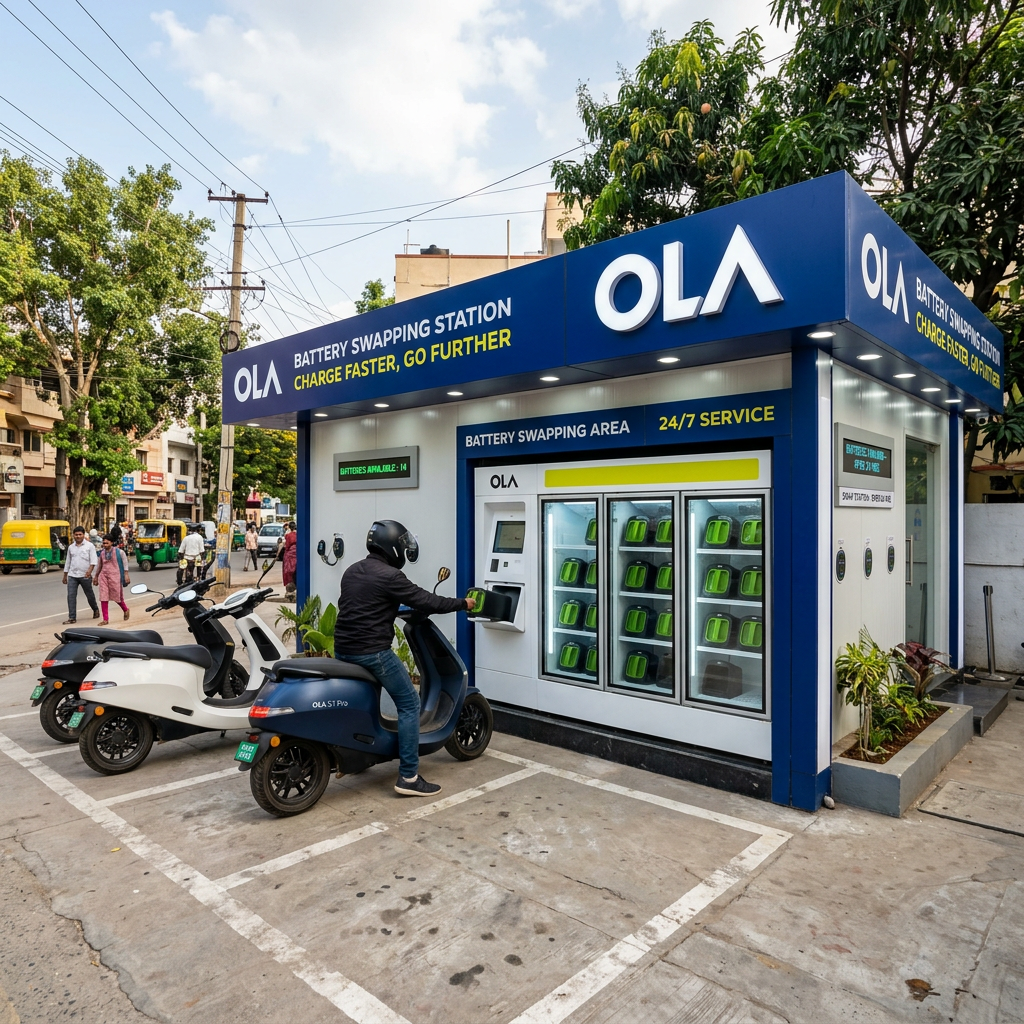
- Dual Portable Battery Setup: At the core of the Gig Scooter’s utility is its modular, dual portable battery architecture. Rather than relying solely on fixed charging infrastructure, which induces operational downtime, the scooter utilizes two removable battery packs.
Ola BaaS:
- This setup allows gig workers to seamless carry out operations via a “Battery-as-a-Service” (BaaS) or hot-swapping model, swapping drained packs for fully charged units at automated networks in minutes.

They can charge 1 battery at home while using the other… then swap them. Or can swap both batteries at a battery swapping station. Ola can open a revenue stream from the swapping station.
- Range: Optimally balanced for high-utilization commercial delivery cycles, the dual-battery configuration delivers a real-world operating range of approximately 110 km to 140 km on a full charge. This ensures a delivery rider can comfortably complete a standard shift without experiencing range anxiety.
Top Speed: Given its positioning as a commercial urban utility vehicle, the Gig Scooter is performance-tuned for density and safety rather than hyper-acceleration. It features a controlled top speed capped at 25 km/h to 45 km/h (depending on the specific regional classification variant, such as low-speed vs. city-speed certification). A 25 km/h variant circumvents the mandatory requirement for a formal driver’s license and registration in India, making it exceptionally accessible for fleet operators onboarding fresh talent.
The ZSeries which is the passenger variant is expected to have a Range of 140kms and top speed of 70kmph.
- Price: Pricing for the Gig Scooter is uniquely aggressively positioned. The vehicle is expected to sit between ₹40,000 to ₹55,000. This makes the capital entry barrier significantly lower than standard consumer electric scooters.
TIMELINE:
Assuming the vehicle completed its formal homologation process in February 2026 (the rigorous testing and certification protocol mandated by agencies like ARAI or ICAT to ensure roadworthiness and regulatory compliance), the timeline for an official market rollout narrows down to 15 August 2026.
The 15 August 2026 Sankalp Mega Event
15 August holds deep institutional and strategic significance for Ola Electric. Historically, the company has utilized India’s Independence Day as its flagship annual launchpad—the grand stage where it unveils major software updates (MoveOS), previews future platforms (like its upcoming electric motorcycles), and announces its most disruptive pricing strategies.
- Infrastructure Maturity: It provides Ola an extra 3 to 4 months post-homologation to aggressively deploy its commercial battery-swapping kiosks across tier-1 cities, ensuring the product is fully viable on day one.
- Maximum Marketing Real Estate: It anchors the commercial scooter as a centerpiece of their “Mission Electric” narrative, capturing national media attention and boosting investor sentiment.
Conclusion
While an immediate rollout this quarter would satisfy local media and autowebsites, a grand commercial launch on 15 August 2026 looks more practical to us at PlugInCaroo. (We would be more than happy to be proved wrong).
Ola’s established playbook, offering the necessary runway to scale the supporting battery-swapping ecosystem required to make the vehicle an absolute market success.
This could also mean the ELUSIVE but economical 1.5kWh (Rs 30,000) Shakti UPS is nearing launch.

