
The most significant technical rift in the market today lies in battery architecture, which directly dictates the company’s long-term revenue potential.
Ather Energy (Fixed Asset Constraint): Ather remains committed to a fixed-battery design. While this allows for superior thermal management (using the chassis as a heat sink) and high performance, it limits the company’s flexibility.
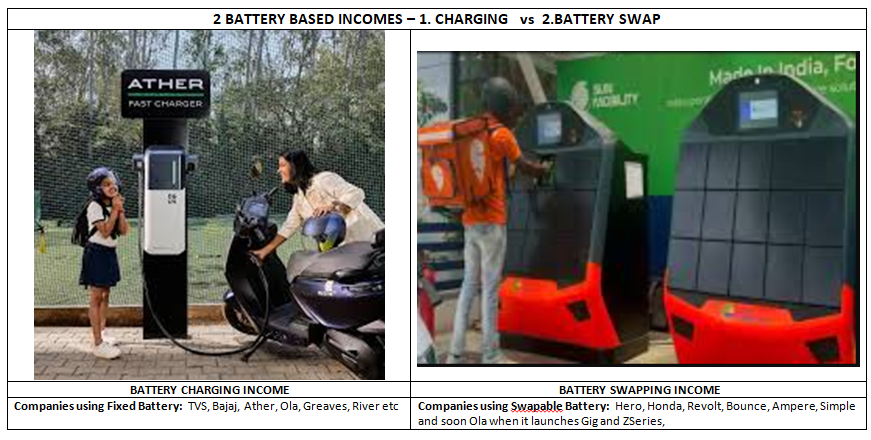
In Ather’s Battery-as-a-Service (BaaS) model, the customer pays a lower upfront price, but the battery remains physically tied to the scooter.
This setup primarily benefits the financer (bank) rather than the manufacturer or the user; the rider often pays a monthly fee for a set “distance bracket” (e.g., 1,000 km), even if their actual usage is significantly lower (e.g., 700 km).
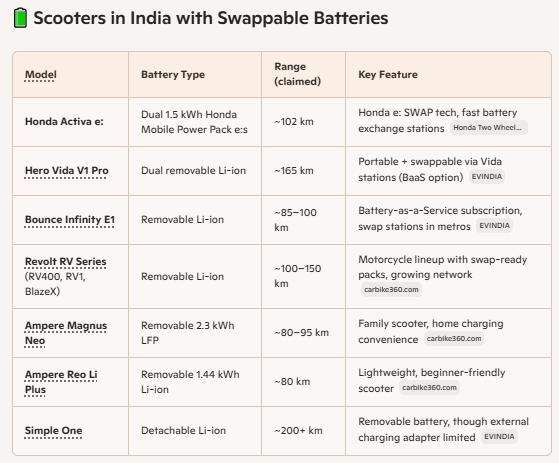
Ola Electric (The Swapping Pivot): In a strategic 2026 pivot, Ola has introduced removable, portable batteries in its Gig and S1 Z series. Unlike the fixed packs in the S1 Pro, these portable units allow Ola to tap into the high-frequency swapping ecosystem.
This hardware shift is a direct attack on the B2B segment, where downtime is expensive.
Look at an eScooter like a printer… and battery as the ink.
Printing companies sell printer cheap… but their ink is always expensive. eScooters can be like that.
The Investor’s Edge: Why Swapping is “The Golden Goose”For an investor, the Battery Swapping model is fundamentally a “utility” play with far higher revenue ceilings than traditional charging.
Companies who use battery swapping or who are in the process of building one:
- Sun Mobility
- Battery Smart
- OLA Electric
- Revolt (one of the options).
The “Free Fuel” Profit HackThe ultimate profit multiplier for swapping companies is solar integration.
By installing rooftop solar at swapping stations, companies like Sun Mobility and Battery Smart can generate electricity for near-zero marginal cost.
They harvest “free” sunlight during the day and sell it at a premium to riders 24/7. This shifts gross margins from a standard 60% (using grid power) to an extraordinary ~95% on every swap.
Market Performance & IPO Landscape (June 2026)Public markets are now differentiating between “Vehicle Sellers” and “Energy Sellers.”
Investor Takeaway: Follow the KilometersTo benefit from this sector, investors must follow the utilization rate.Household scooters are idle 90% of the time, providing little post-sale revenue.
Gig-worker scooters are revenue-generating assets every hour of the day.
While Ather offers a premium hardware experience, its fixed-battery model misses the “Energy-as-a-Fuel” revenue loop.
Conversely, companies embracing portable batteries and swapping stations are building a captive, lifelong income stream that is decoupled from the hardware sale and accelerated by the growth of India’s 7.7 million (and growing) gig workers.
The Verdict: For long-term wealth creation, the real value isn’t in the scooter that plugs into a wall; it’s in the portable battery that swaps at a station, generating recurring revenue every 100 kilometers per scooter per day.

