
Ola Electric’s retail presence is now just 45 stores (list is given below as per their website) across 8 Indian cities — highlights its limitations.
While the company once grew beyond 3,000 stores and has established visibility in certain urban centers, the distribution of outlets reveals a fragmented strategy that has not fully aligned with India’s strongest demand markets.

The recent decision to invite dealership partners marks a significant pivot, acknowledging that direct sales were never Ola’s strongest point and that its core strengths lie in manufacturing and servicing.
Concentration in Select Metros
eScooter sales are highest in Maharashtra, Uttar Pradesh, Karnataka, Tamil Nadu and Kerala.
The largest cluster of stores is in Bengaluru, with 12 outlets, reflecting Ola’s home base and strong EV adoption in Karnataka.
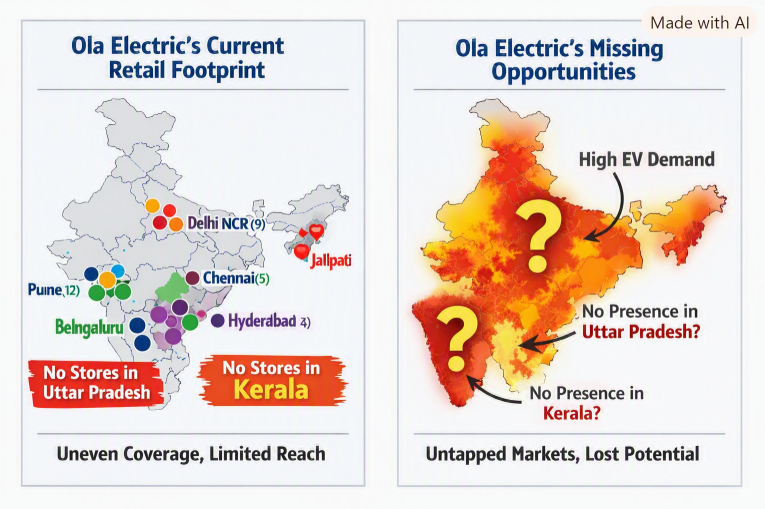
Delhi NCR follows with nine, leveraging population density and visibility.
- Karnataka has its main office… but just 2 Cities are covered there – Bengaluru & Hyderabad.
- Delhi in spite of being a small place has 9 Shops
- In Maharashtra Ola has covered 2 cities – 2 (Mumbai & Pune)
- Ola has a factory in Tamil Nadu… but just 1 City there – Chennai.
Absence in High-Potential States
The most glaring gaps are in Uttar Pradesh and Kerala. Uttar Pradesh, India’s largest state by population and a powerhouse in two-wheeler sales, has no Ola presence. Kerala, known for highest per-capita EV adoption and strong consumer purchasing power, is completely ignored.
Even in Tamil Nadu, where Ola’s factory is located, retail presence is restricted to Chennai alone, leaving other high-potential cities untapped. Even in Tamil Nadu, where Ola’s factory is located, retail presence is restricted to Chennai alone, leaving other high-potential cities untapped.
Manufacturing Strength vs. Retail Weakness
This distribution suggests that Ola’s strength lies not in retail sales but in manufacturing scale and vehicle servicing.
The Tamil Nadu factory demonstrates Ola’s ability to produce at scale, but the lack of retail penetration shows that sales and distribution were never its forte.
By attempting to control retail directly, Ola stretched itself thin and failed to capture demand in critical markets.

The Strategic Pivot: Dealership Partners
Recognizing this weakness, Ola has recently opened its doors to dealership partners. This move is strategically sound:
- Leveraging local expertise: Dealers understand regional demand patterns far better than a centralized rollout.
- Expanding reach quickly: Partnerships allow Ola to penetrate high-demand states like UP and Kerala without bearing the full burden of retail operations.
- Focusing on core strengths: Ola can concentrate on manufacturing, innovation, and after-sales service — areas where it has competitive advantage.
- Repair and service focus: By shifting retail responsibility, Ola can strengthen its repair and maintenance ecosystem, ensuring customer satisfaction and long-term brand loyalty..
Conclusion
Ola Electric’s initial retail footprint was haphazard and defensive, clustering in comfort zones while neglecting high-demand states.
By decentralizing retail and focusing on manufacturing and servicing, Ola is better positioned to scale sustainably, capture untapped markets, and compete effectively against rivals. This pivot could transform Ola from a company struggling with distribution gaps into one that leverages partnerships to achieve true national presence.

