An Analysis of Ola Electric’s Battery Manufacturing Strategy in India
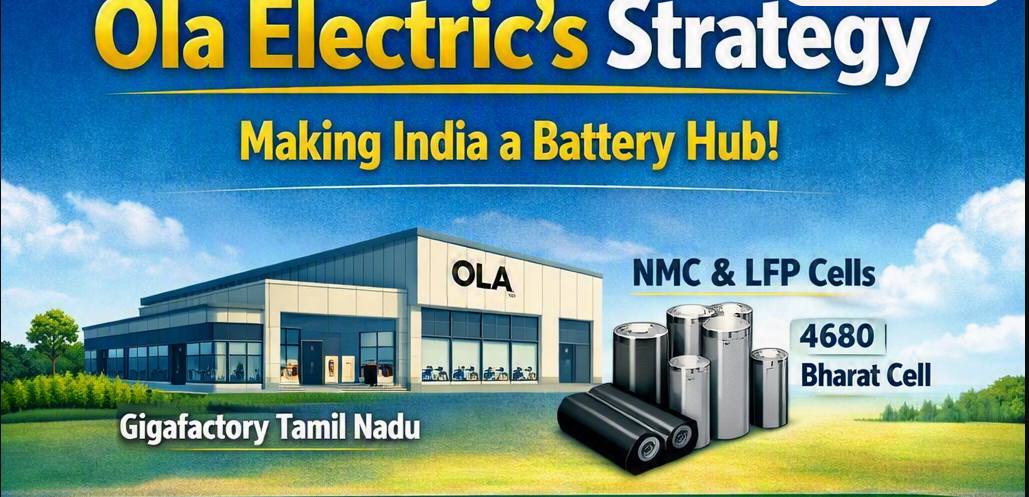
India’s electric vehicle (EV) revolution is transitioning from the simple assembly of imported components to the domestic, foundational manufacturing of battery cells. At the epicenter of this shift is Ola Electric’s Gigafactory in Krishnagiri, Tamil Nadu.

By developing two distinct cell chemistries in-house—the 46100 Lithium Iron Phosphate (LFP) cell and the 4680 Nickel Manganese Cobalt (NMC) “Bharat Cell”—the company is executing a dual-pronged manufacturing strategy.
Understanding the advantages and disadvantages of these two chemistries is essential to realizing how this localized capability could completely alter the landscape of the Indian EV market.
(Pls don’t buy or sell shares based on this information alone. You need to check with your financial advisor before investing in Stock Market. This is just an example to understand the IPO and demerger process… the IPO and Demerger may or may not happen… the allotment could be much less… or there could not be any fresh allotment … this is just for education purpose ONLY).
Lets try to analyse them:
1. The 46100 LFP Cell: The Mass-Market Workhorse
Lithium Iron Phosphate (LFP) chemistry has seen a massive global resurgence, primarily driven by its safety profile and falling production costs. For the Indian context, producing large-format cylindrical LFP cells (like the 46100) represents a highly pragmatic approach geared toward cost leadership, safety, and longevity.
Advantages of LFP
- Cost Efficiency: LFP completely eliminates expensive, ethically controversial, and geopolitically volatile minerals like cobalt and nickel. Replacing them with abundant iron and phosphate drastically lowers raw material input costs, enabling a significantly cheaper baseline production floor.
- Thermal Stability and Safety: Indian climatic conditions demand highly stable batteries. LFP cells possess a significantly higher thermal runaway threshold compared to NMC, making them inherently safer and substantially less prone to fire or thermal failure during peak summer temperatures.
- Unmatched Cycle Life: LFP cells can comfortably endure 3,000 to 5,000 charge cycles with minimal capacity degradation. This longevity means the battery pack will likely outlast the structural life of the vehicle itself, making it an ideal choice for high-mileage daily commuters and commercial fleet operators.
Disadvantages of LFP
- Lower Energy Density: LFP cells store less energy per unit of weight and volume compared to NMC. To achieve a given riding range, an LFP battery pack must be physically larger and heavier, which can complicate the chassis design and weight distribution of lightweight two-wheelers.
- Voltage Flatness: LFP chemistry exhibits a very flat discharge curve, meaning the cell voltage remains nearly constant across most of its discharge cycle. This makes it notoriously difficult for the Battery Management System (BMS) to accurately estimate the remaining state of charge (SoC).
2. The 4680 NMC “Bharat Cell”: The Performance Engine
Nickel Manganese Cobalt (NMC) chemistry is the established global standard for high-performance and premium electric vehicles. Ola’s development of the 4680-format NMC cell is aimed squarely at segments where space constraints dominate and high energy density is required.
Advantages of NMC
- Superior Energy Density: NMC cells excel at packing maximum energy into a compact volume and light weight. This directly translates into longer riding range per charge, faster acceleration, and lower overall vehicle curb weight—critical factors for premium commuter scooters and high-speed electric motorcycles.
- High Discharge Rates: NMC cells can handle higher peak discharge currents without severe voltage drops, allowing electric vehicles to deliver sudden bursts of power and top speeds required for sporty performance models.
- Cold Weather Resilience: While less critical in major parts of India, NMC maintains its discharge capacity and performance much better in extreme cold climates compared to LFP.
Disadvantages of NMC
- High Raw Material Costs & Vulnerability: Relying heavily on nickel, manganese, and cobalt makes NMC cells inherently expensive to produce. Furthermore, the supply chains for nickel and cobalt are concentrated globally, exposing manufacturing costs to international market volatility.
- Thermal Sensitivity: NMC cells have a lower thermal runaway temperature and are more sensitive to high ambient temperatures. They demand sophisticated active thermal management systems (cooling loops) and strict BMS monitoring to operate safely in hot Indian environments.
- Shorter Cycle Life: Typically offering 1,000 to 2,000 cycles before reaching 80% state of health, NMC cells degrade faster than LFP cells, meaning high-mileage users may need a battery replacement earlier in the vehicle’s lifespan.
Comparison Summary Table
| Parameter | 46100 LFP Cell | 4680 NMC Cell (Bharat Cell) |
| Cathode Chemistry | Lithium Iron Phosphate | Nickel Manganese Cobalt |
| Volumetric / Gravimetric Energy Density | Moderate (~160–180 Wh/kg) | High (~240–280 Wh/kg) |
| Estimated Base Cost (Ola In-House) | $60 – $75 / kWh | $85 – $100 / kWh |
| Effective Cost (Post-PLI Subsidy) | $35 – $50 / kWh | $50 – $65 / kWh |
| Thermal Runaway Temp | High (~270°C+) — Very Safe | Lower (~210°C) — Requires Active Cooling |
| Cycle Life | 3,000 – 5,000 cycles | 1,000 – 2,000 cycles |
| Target Application | Entry-level EVs, B2B fleets, commuters | Premium scooters, electric motorcycles |
How Domestic Dual-Cell Manufacturing Makes All the Difference
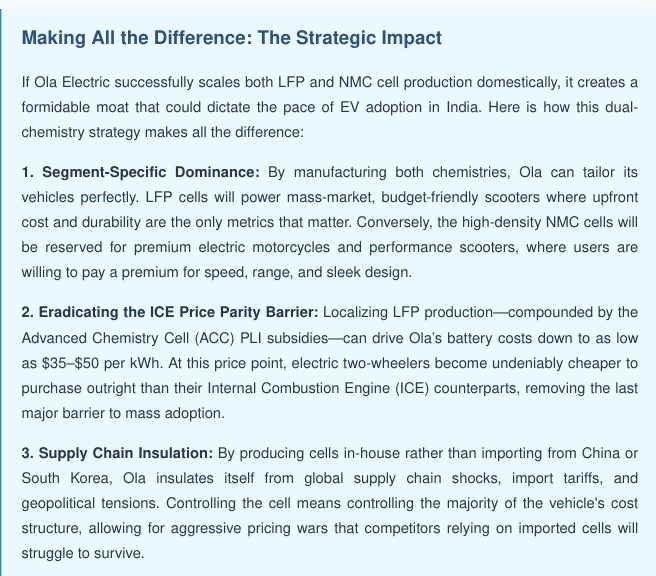
If Ola Electric successfully scales both LFP and NMC cell production domestically, it creates a structural advantage that could reshape EV adoption in India for several key reasons:
- Precision Market Segmentation: Producing both chemistries allows Ola to optimize its lineup rather than forcing a one-size-fits-all compromise. LFP cells will power budget-conscious, entry-level scooters where low purchase price and extreme durability drive decisions. Meanwhile, NMC cells will power high-margin premium models and electric motorcycles where range and speed are the primary purchasing drivers.
- Cracking Internal Combustion Engine (ICE) Price Parity: Battery packs typically represent 35% to 45% of an EV’s total cost. By localizing LFP cell production and leveraging India’s Advanced Chemistry Cell (ACC) Production Linked Incentive (PLI) scheme—which offers up to $30–$35/kWh in subsidies—Ola can potentially push effective cell costs down to $35–$50 per kWh. At this threshold, upfront retail prices for electric two-wheelers can match or undercut equivalent petrol scooters without relying on customer-facing subsidies.
- Supply Chain Insulation and Margin Control: By manufacturing cells domestically rather than buying finished cells from foreign suppliers, Ola captures the margin that would otherwise go to external cell makers. Furthermore, localized cell assembly protects the company from global supply bottlenecks, shipping cost spikes, and foreign import tariffs.
Conclusion
The choice between LFP and NMC is not a matter of one chemistry being universally superior to the other; rather, they are specialized tools tailored for different operational requirements. LFP brings unbeatable safety, long service life, and rock-bottom manufacturing costs for mass-market adoption. NMC offers the concentrated energy and power output required to challenge traditional combustion vehicles in performance segments.
By mastering the scaled, domestic production of both cell types within India, Ola Electric is positioned not just to secure its own supply chains, but to lower the economic threshold for electric vehicle adoption across the country.
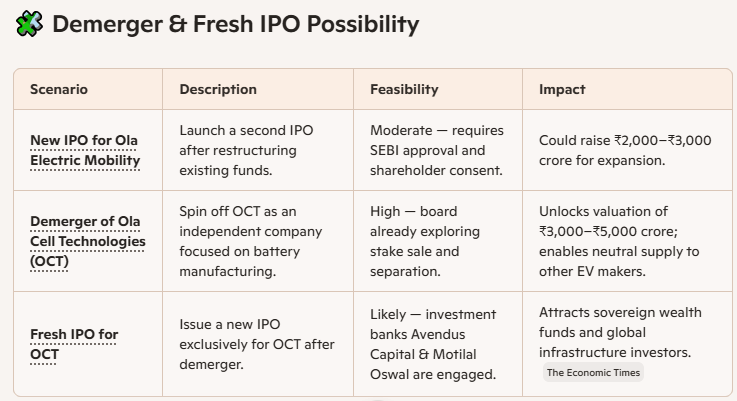
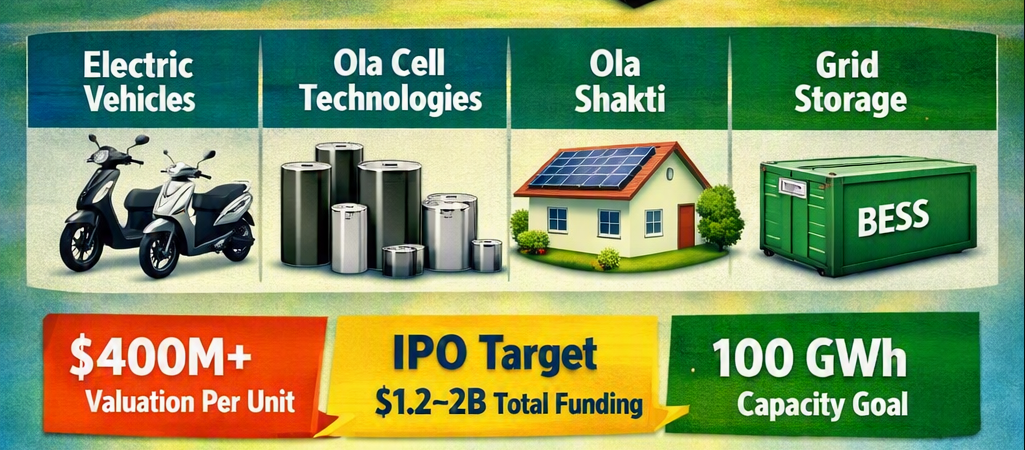
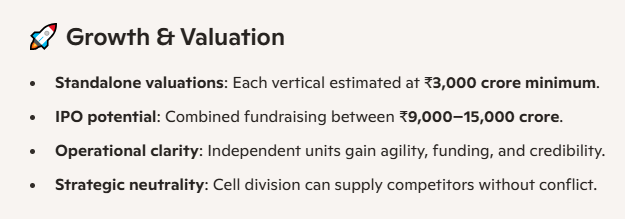
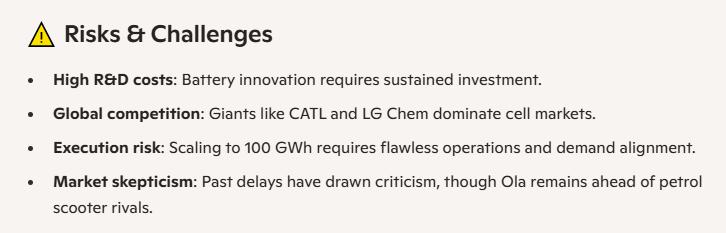
OLA ELECTRIC FRESH IPO?
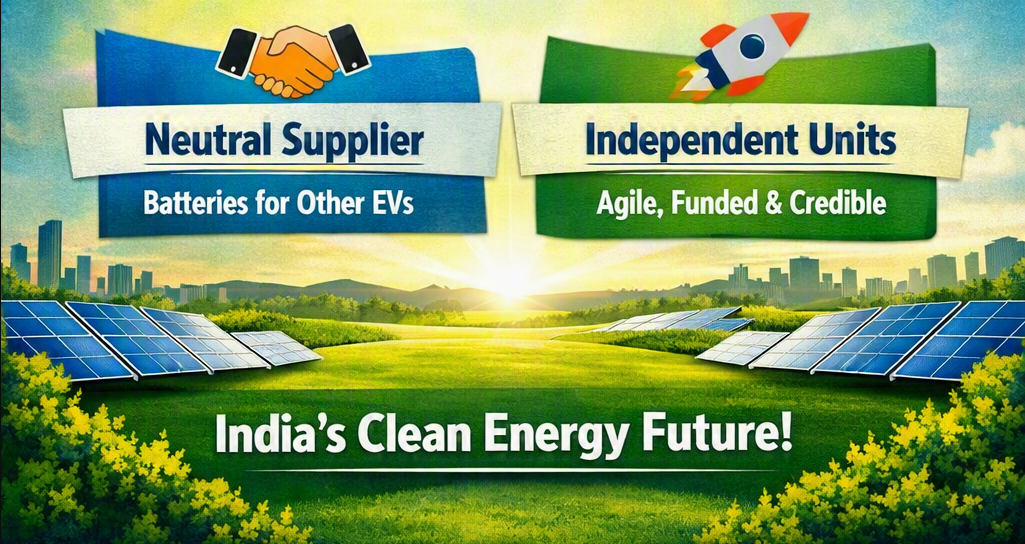
Ola Electric can legally launch a new IPO or spin off its battery arm, Ola Cell Technologies (OCT), into a separate entity and issue a fresh IPO for that division. The company’s board and financial advisors are already exploring this route to unlock value and attract new investors.